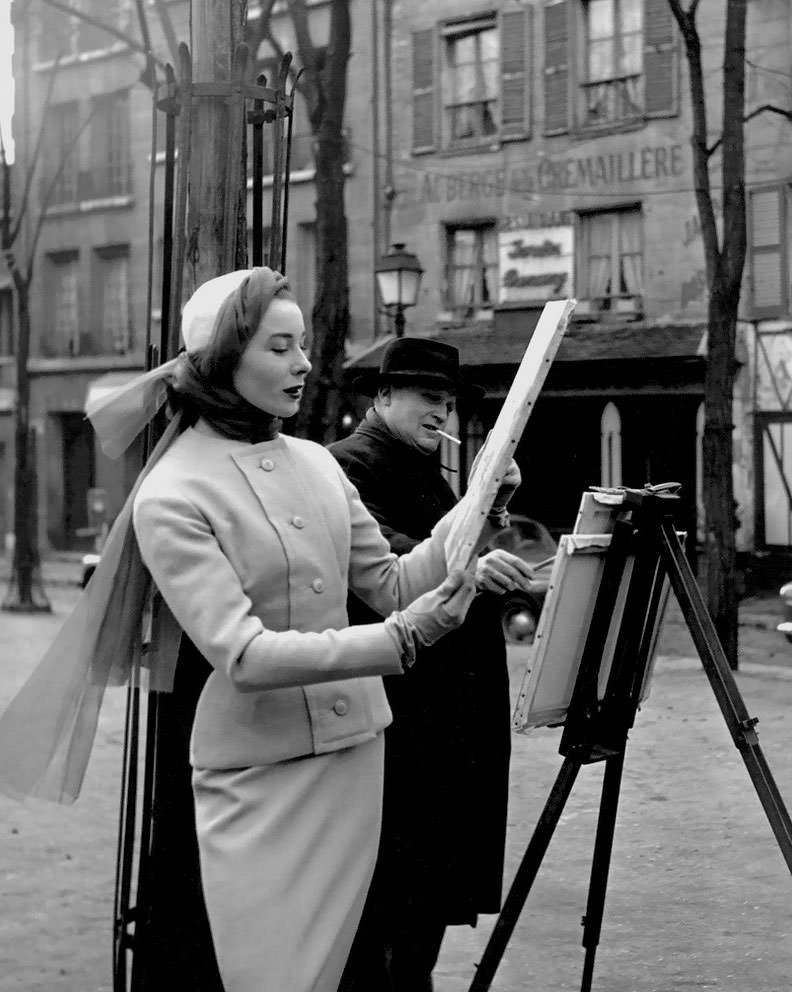
Poised beside a street-side easel, Bettina Graziani wears a crisp suit by Hubert de Givenchy, its clean lines and prominent buttons emphasizing the refined silhouette that defined early-1950s Paris fashion. A neatly tailored jacket and slim skirt are paired with gloves and a dramatic headscarf whose long ties trail behind her, turning a practical accessory into a striking flourish. Her calm profile and composed stance suggest a model’s discipline, yet the scene feels lived-in rather than staged.
Behind her, an artist in a dark coat and brimmed hat leans toward his work, cigarette in hand, adding a note of everyday grit to the couture elegance in the foreground. The urban backdrop—shuttered windows, bare trees, and weathered shopfront signage—anchors the photograph in postwar street life, where fashion photography often borrowed the authenticity of the city. The contrast between the soft tailoring and the rough textures of the street gives the image its tension and charm.
Givenchy’s design reads as a lesson in mid-century chic: minimal ornament, impeccable structure, and an ease that lets the wearer command attention without excess. Bettina, celebrated as one of France’s first supermodels, embodies that modern ideal—confident, youthful, and unmistakably stylish—while the painter’s presence hints at the ongoing conversation between couture and the arts. As a piece of fashion history, the photograph doubles as a cultural portrait, capturing how Parisian elegance was performed, observed, and recorded in 1953.