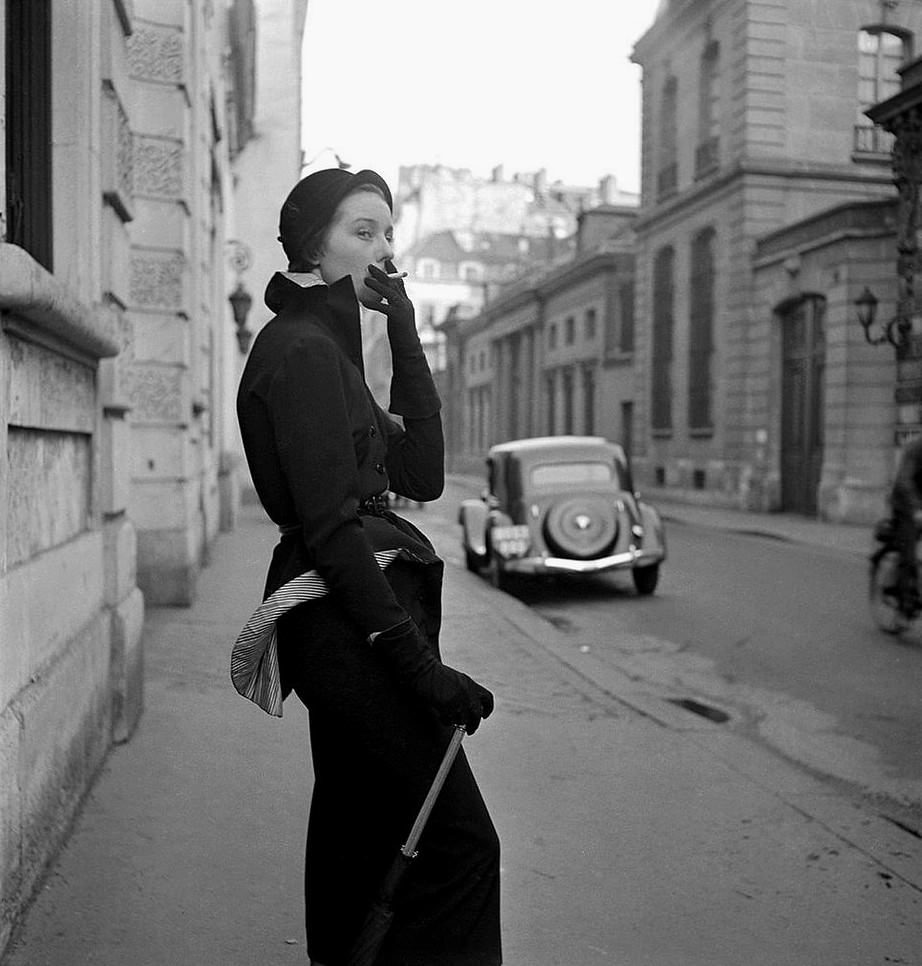
Poised on a quiet city street, Bettina Graziani turns in profile with the effortless assurance that made her a defining face of postwar French fashion. A structured suit by Jacques Fath shapes a sleek silhouette—nipped at the waist, strong at the shoulders—while long gloves and a small hat sharpen the look into pure 1949 sophistication. Her hand lifts toward her mouth in a gesture that feels both candid and staged, the kind of editorial moment that blurs everyday life with high style.
Behind her, stone façades, tall windows, and a parked automobile place the scene firmly in mid-century urban Europe, where couture moved from salons to sidewalks and the city itself became a set. The crisp contrast of the photograph emphasizes texture: tailored wool against smooth gloves, a hint of striped lining flicking at the hem, and the hard geometry of architecture framing the model’s curve. Even with traffic receding in the background, the composition keeps attention fixed on the drama of the outfit and the calm control of her pose.
Fashion historians often point to images like this when describing how the early “supermodel” emerged—less a mannequin and more a personality who could carry a designer’s vision into the public imagination. Jacques Fath’s suit reads as both practical and theatrical, a statement of modern elegance in the late 1940s, when couture helped set the tone for renewed cultural confidence. For collectors and researchers of vintage fashion photography, this portrait of Bettina Graziani remains an enduring reference point for Paris couture style, postwar glamour, and the visual language of street-based editorial fashion.