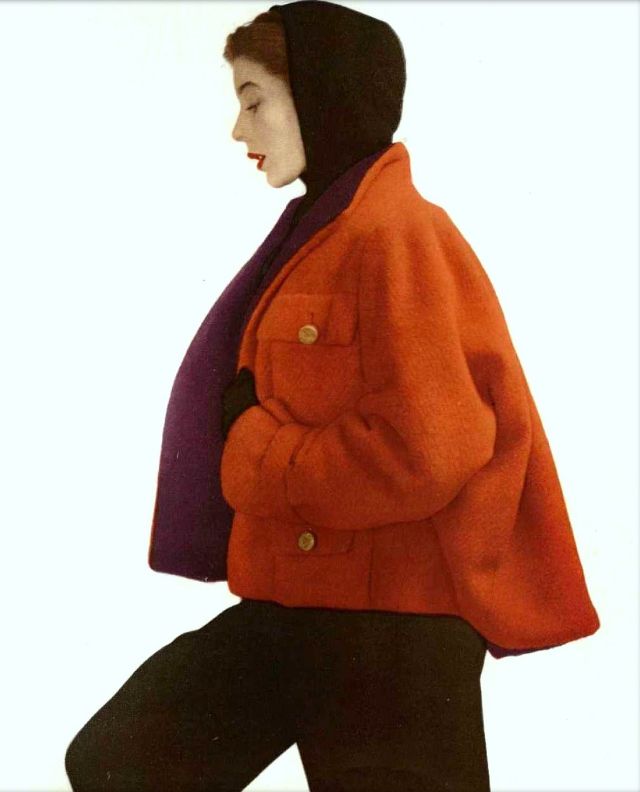
Seen in profile against a stark white backdrop, Bettina is styled in a brick-red wool jacket with a vivid purple lining that flashes as the fabric swings open. A black hooded sweater frames her face and neck, creating a graphic silhouette, while black gabardine pants keep the look streamlined and modern. The restrained pose—head slightly bowed, hands tucked close—lets the color contrast and tailored construction do the talking.
Manguin’s design reads as a study in mid-century practicality elevated to couture: generous, rounded volume through the body, flap pockets with bold buttons, and a collarless ease that layers cleanly over knitwear. The purple interior is more than a hidden detail; it turns the jacket into a moving composition, hinting at luxury and playfulness within an otherwise pared-back ensemble. Even in a studio setting, the outfit suggests city movement—cold air, quick strides, and clothes built to travel.
Fashion historians often point to images like this when tracing the shift from postwar formality toward a sharper, youth-oriented simplicity in the early 1950s. The strong blocks of red, purple, and black anticipate later color-field styling, while the hood introduces a casual note that feels surprisingly contemporary. For searches around Bettina, French fashion modeling, and 1950s couture outerwear, this portrait stands out as an emblem of how a single jacket could signal both elegance and everyday freedom.