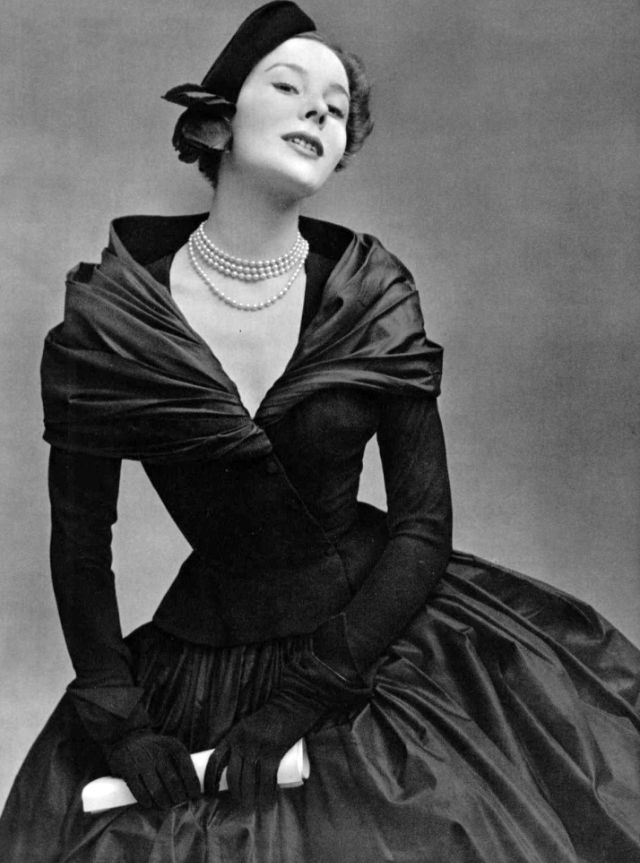
Poised with her chin lifted and a knowing half-smile, Bettina Graziani embodies early-1950s Paris couture in a sharply tailored Christian Dior ensemble. A black matte wool bodice sculpts the torso with precise seams and a deep neckline, while long gloves and a triple strand of pearls heighten the air of formal elegance. Draped around her shoulders, a dark shawl frames the silhouette like a theatrical curtain, inviting the eye toward the fitted waist.
Texture does much of the storytelling here: the bodice’s sober wool contrasts with the glossy, light-catching black taffeta skirt that swells outward in rich folds. The skirt’s volume suggests the era’s fascination with shape and movement, even in a still image, as if the fabric might rustle with the slightest turn. Set against a plain studio backdrop, every detail—buttons, drape, and sheen—reads clearly, turning the garment into the true subject of the portrait.
Finishing the look, a small black cap sits at an angle, punctuated by a red rose that offers the only deliberate flash of color in a predominantly dark palette. The styling captures Dior’s 1951 vision of sophisticated eveningwear: controlled, dramatic, and meticulously balanced between restraint and romance. For fashion history and culture, the photograph stands as a crisp record of couture’s postwar confidence and the model’s role in translating atelier craftsmanship into timeless imagery.