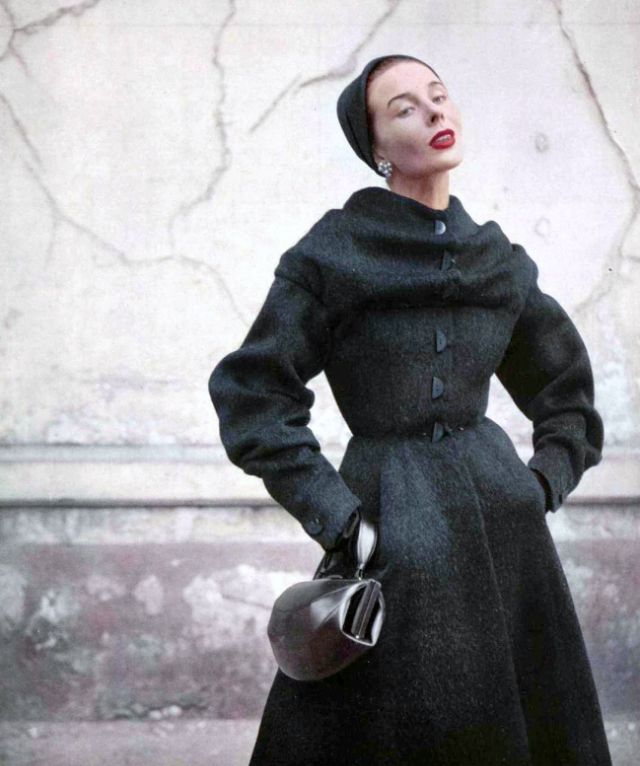
Poised against a weathered plaster wall veined with hairline cracks, Bettina models a furry wool redingote whose sculpted silhouette reads as both practical outerwear and high fashion statement. The coat’s narrow waist and full skirt create a classic 1950s line, while the cape-like shawl draped over her shoulders adds a sense of protective drama. A headscarf frames her face, and the bold red of her lipstick punctuates the otherwise dark, textural palette.
Jean Dessès’ design details do the real storytelling here: whimsical half buttons march down the front like small punctuation marks, emphasizing the garment’s structured elegance. The plush wool surface appears almost velvety in the light, contrasting with the crisp seams and rounded shoulders. In her gloved hand she carries a compact handbag with a sleek clasp, reinforcing the era’s taste for refined accessories and controlled glamour.
Even without a named street or studio backdrop, the photograph feels anchored in postwar couture culture, where tailoring and attitude worked together to project confidence. Bettina’s upward tilt and relaxed stance turn the redingote into a character of its own—protective cape, fitted bodice, and sweep of skirt moving as one. For readers searching 1952 fashion photography, Jean Dessès couture, or Bettina style history, this image distills the period’s elegance into a single, unforgettable pose.