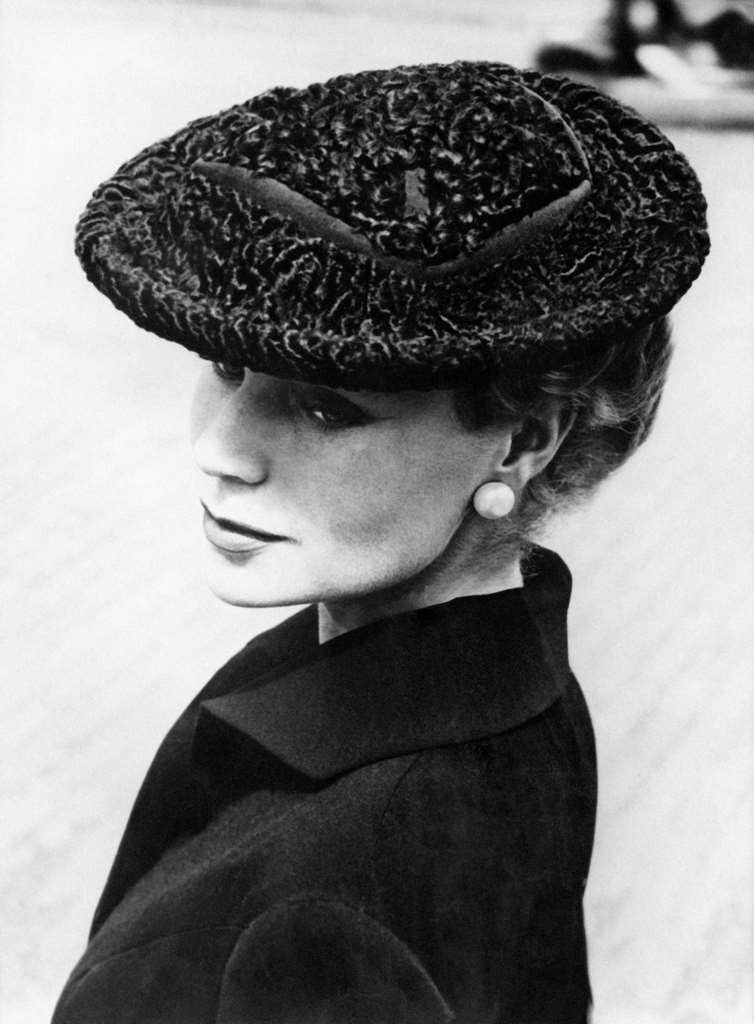
Perched low and worn forward on the forehead, a round hat in gray astrakhan commands the frame with its dense, curled texture and sculptural silhouette. The encrusted grosgrain forms the crown like a raised ring, adding crisp structure against the soft, fur-like surface. In profile, the styling feels deliberate and modern—an exercise in restraint where material and shape do all the talking.
Jacques Fath’s Paris 1955 design reads as quintessential mid-century couture millinery, balancing drama with impeccable control. The hat’s forward tilt casts a slight shadow over the eyes, sharpening the wearer’s gaze and emphasizing the clean line of cheekbone and lipstick. Paired with a dark, tailored coat and simple round earrings, it evokes an era when accessories were engineered to frame the face as much as to complete an outfit.
Beyond its elegance, the captioned detail—astrakhan from South Africa—points to the global supply chains behind haute couture and fashion culture of the period. This kind of editorial fashion photograph works as both advertisement and artifact, preserving the tactile logic of luxury: texture, contrast, and craftsmanship. For historians of 1950s Paris fashion, it’s a compact lesson in how couture translated exotic materials into disciplined, urban sophistication.