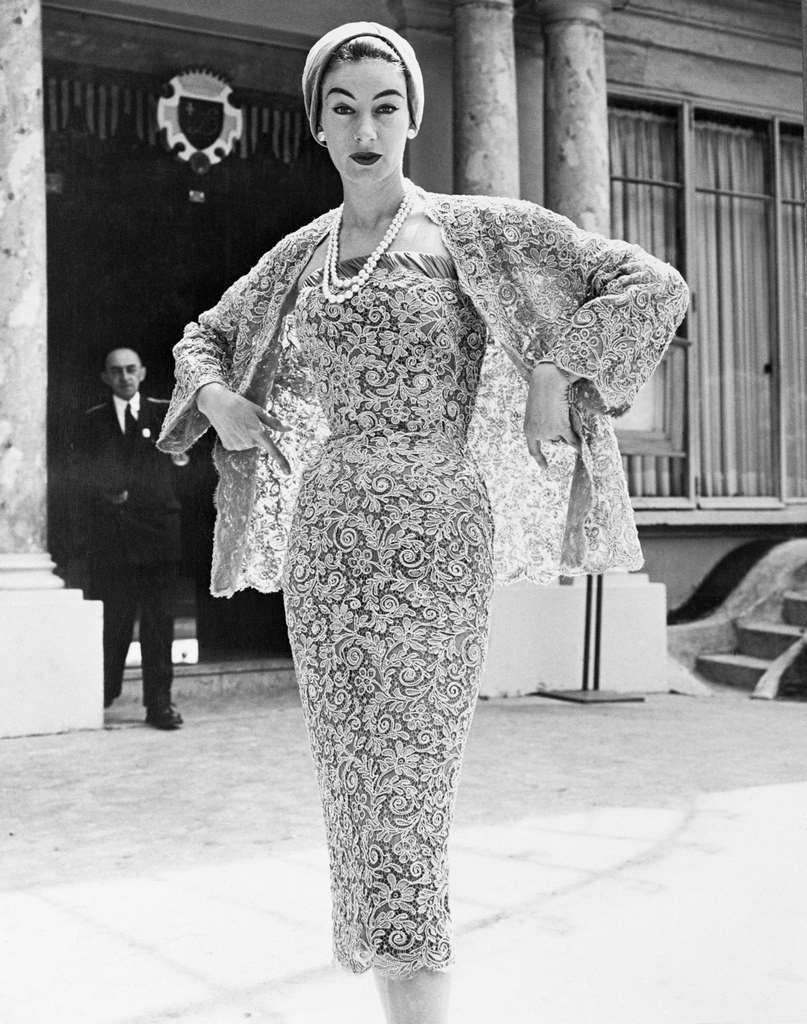
Poised in a sunlit courtyard, a model advances with the assured, choreographed confidence of mid-century couture. Her silhouette is sculpted into a close-fitting, knee-length dress densely worked with swirling embroidery, a surface that reads like lace translated into architecture. A matching, open-front jacket frames the waist and shoulders, while a wrapped headscarf and a strand of pearls sharpen the look into a complete fashion statement—elegant, deliberate, and unmistakably designed for attention.
Jacques Fath’s name on the title invites a closer look at how the ensemble balances sensuality with discipline, a hallmark of high fashion in the postwar era. The cut emphasizes a narrow waist and clean line through the hips, letting the intricate textile do the talking rather than relying on excess volume. Details such as the structured neckline, fitted sleeves, and coordinated outer layer suggest atelier precision, the kind of craftsmanship associated with Paris couture and its culture of fittings, finishing, and polished presentation.
Behind the model, the setting’s columns and curtained windows lend a stage-like backdrop that turns a simple walkway into a runway. A suited figure in the distance underscores the public nature of couture—watched, evaluated, and meant to be seen in motion—while the camera freezes the moment at its most theatrical. For fashion history and culture enthusiasts, the photograph reads as both style documentation and storytelling: a snapshot of how an ensemble by Jacques Fath could project modern glamour through fabric, posture, and perfectly controlled detail.