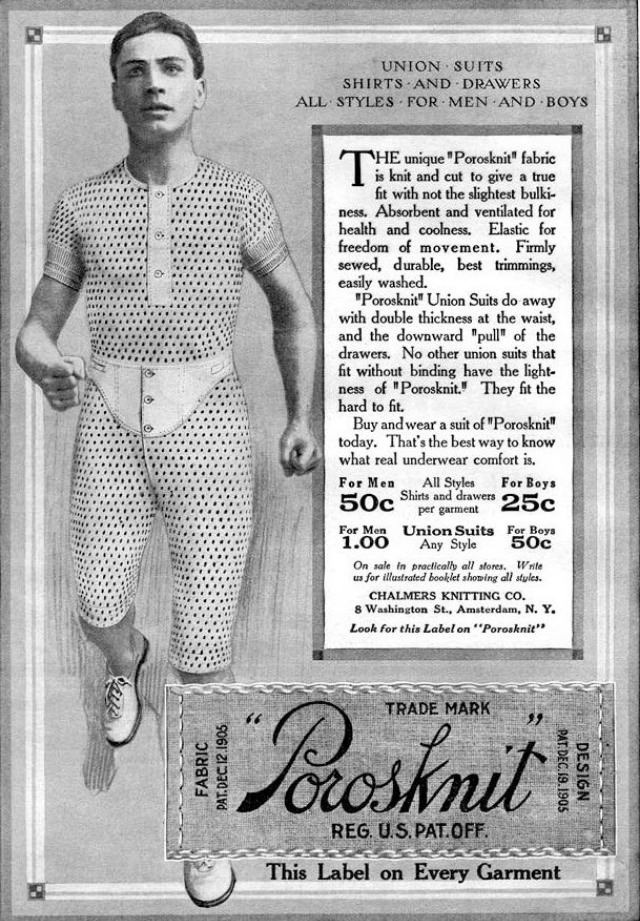
At the left edge of the advertisement, a young male model stands in a snug, perforated knit union suit, posed like a confident athlete to sell the promise of comfort. The garment’s short sleeves and buttoned placket are rendered with crisp detail, while the dotted “Porosknit” fabric pattern visually reinforces the sales pitch of ventilation and lightness. Below, a bold trademark label—“Porosknit,” “REG. U.S. PAT. OFF.”—anchors the page the way a clothing tag would anchor a real purchase.
Typography does much of the talking on the right, where the copy touts absorbency, health, coolness, and freedom of movement, turning underwear into a modern, rational improvement. The ad offers “Union Suits,” “Shirts and Drawers,” and “All styles for men and boys,” reflecting how early-1900s fashion marketing leaned on both practicality and the authority of “best trimmings” and durability. Prices are prominently printed in cents and dollars, and the brand name is repeated for quick recognition—an early lesson in repetition and readability for mass audiences.
Near the bottom, the manufacturer is identified as Chalmers Knitting Co., with an address in Amsterdam, N.Y., and a prompt to “Look for this Label,” emphasizing authenticity in an era of competing knitwear claims. Even the small print—patent and design references—signals how companies used legal language to make everyday clothing feel innovative. As a piece of fashion and culture history, the ad reveals how men’s and boys’ underwear was marketed not as a hidden necessity, but as a badge of modern comfort, hygiene, and efficiency.