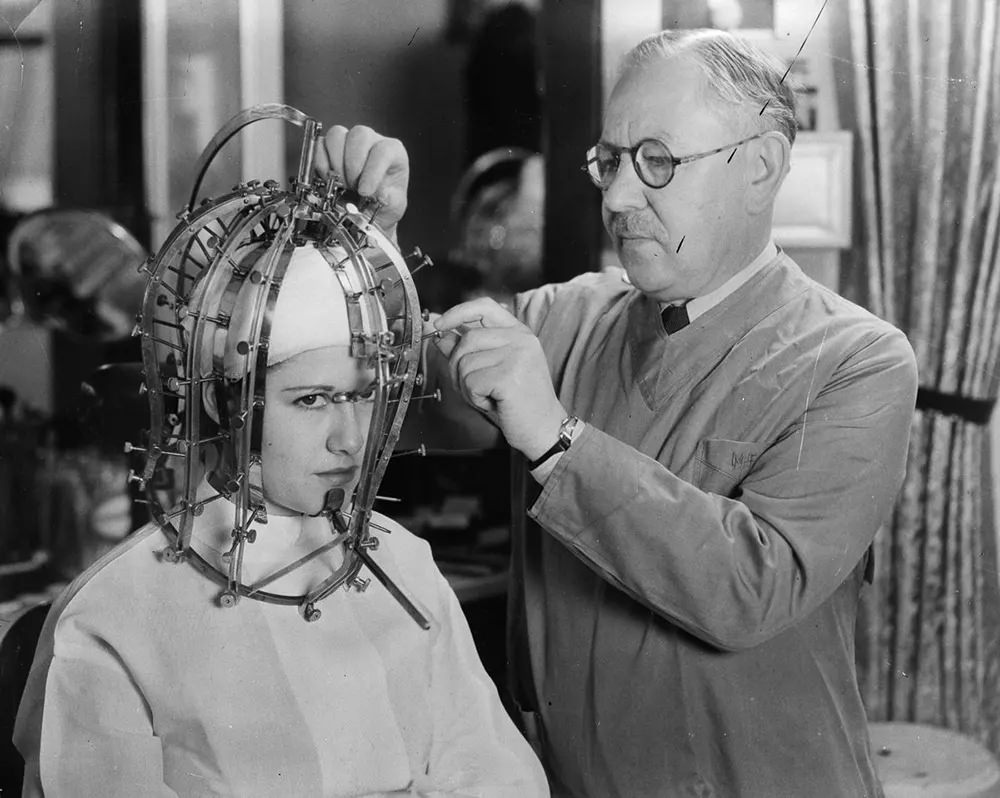
A young woman sits rigidly while a cage-like metal framework encircles her head, its rings and screws bristling like a piece of laboratory equipment rather than a salon tool. The device—often dubbed a “Beauty Calibrator” in 1930s press lore—hovers close to the brow, cheeks, and chin, suggesting a quest to reduce the face to measurable points and angles. Her expression is tense and wary, underscoring how strange it must have felt to have “ideal” proportions evaluated with hardware.
To the right, a man in a work coat and round spectacles adjusts the apparatus with careful, clinical attention, as if calibrating an instrument rather than addressing a person. The scene blends the aesthetics of early twentieth-century science with the booming beauty industry, when modernity promised that technology could diagnose and correct almost anything—including perceived facial “flaws.” In an era fascinated by measurement and standardization, gadgets like this traded on the authority of precision, even when the goal was something as subjective as attractiveness.
Seen today, the Beauty Calibrator reads as both curiosity and cautionary tale: a striking example of how fashion, culture, and pseudo-scientific confidence could merge into spectacle. The photograph is SEO-friendly fodder for anyone researching 1930s beauty devices, vintage cosmetic technology, and the history of beauty standards, offering a vivid window into the anxieties and aspirations marketed to consumers. Its unsettling elegance lies in the contrast between cold metal geometry and the human face beneath it, reminding viewers that the pursuit of “perfection” has long been engineered as much as it has been desired.