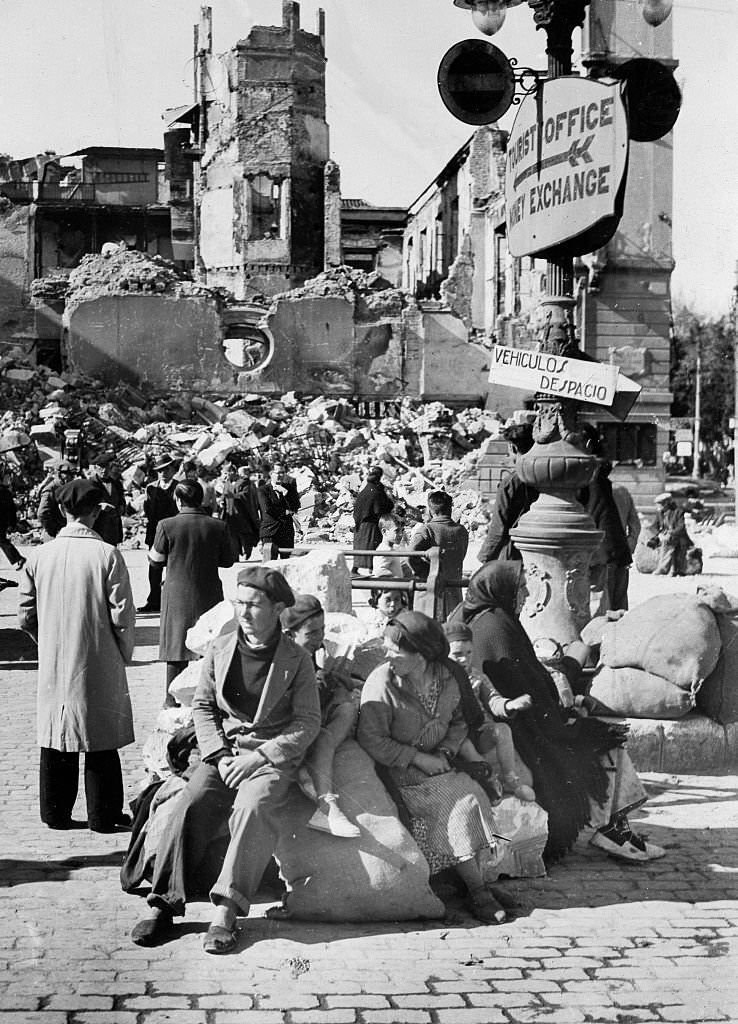
Along a shattered streetscape, refugees pause on bulging sacks and bundles, turning a pile of possessions into a makeshift bench while the city around them lies broken. Behind their hunched shoulders, a building stands gutted to its shell, and the roadway is clogged with rubble that blurs the line between sidewalk and ruin. The ordinary mix of coats, scarves, and workwear underscores how abruptly daily life was interrupted, leaving civilians to wait in public with everything they could carry.
Signs still hang from a street fixture—one reading “POST OFFICE EXCHANGE,” another warning “VEHICULOS DESPACIO”—a jarring reminder of civic routines continuing on paper while institutions and homes collapse in reality. People drift through the foreground and midground in small knots, some watching, some moving on, all framed by debris and exposed masonry. The photograph’s tension lives in these contrasts: commerce and communication advertised above a scene of displacement, order suggested by signage while war dictates the pace.
Dated in the title to the aftermath of the city’s capture by the Nationalists on 7 February 1937, the image speaks to the humanitarian consequences of the Spanish Civil War as much as to its military milestones. It captures the moment when victory announcements and changing flags translate into exhausted bodies, uncertain directions, and the fragile security of a single bag. For readers searching for Spanish Civil War refugees, civilian displacement, and urban destruction, this photograph offers an unvarnished window into what conquest looked like at street level.