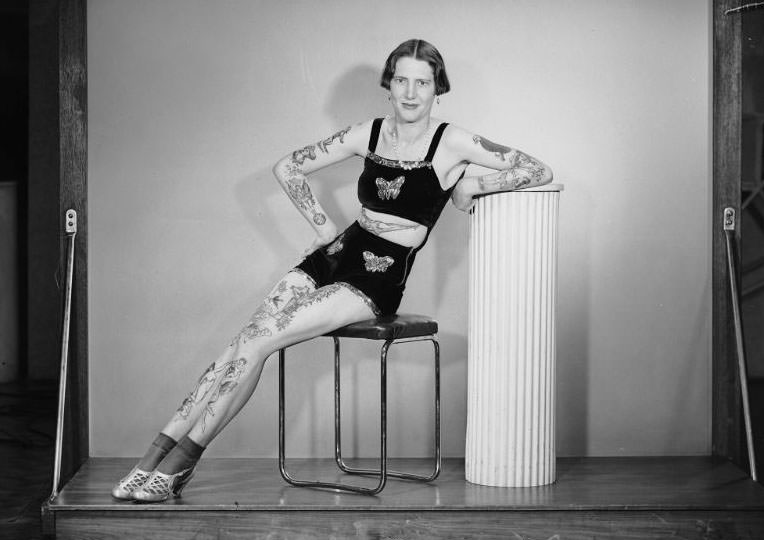
Leaning with easy confidence against a fluted studio pedestal, a tattooed woman poses in a sleek two-piece outfit adorned with butterfly motifs, her gaze meeting the camera without apology. The setting is spare—plain backdrop, simple chair, and a shallow stage—so the viewer’s attention lands on the living artwork that covers her arms and legs. Even in a carefully lit studio, the pose feels less like a curiosity act and more like a statement of self-presentation.
Across her skin, bold figurative designs and decorative patterns read like a personal gallery: large motifs on the upper arms, intricate linework down the forearms, and sprawling scenes along the thighs and calves. The photograph’s clarity invites close looking, from the way the ink contours with muscle and bone to the contrasts between dark shading and lighter spaces. As an “Artworks” entry, it reminds us that tattooing in the 1930s was already an established visual language—one carried by bodies rather than canvases.
Dated 25 December 1937 and placed in Australia by the title, this portrait offers a striking lens on interwar popular culture, performance, and the shifting boundaries of respectability. Studio portraits like this were often made to be circulated, collected, or used as promotional material, and the composed backdrop hints at that public-facing purpose. For readers interested in tattoo history, women’s social history, or Australian photography, it’s a vivid, searchable record of how ink, fashion, and confidence converged in one moment.