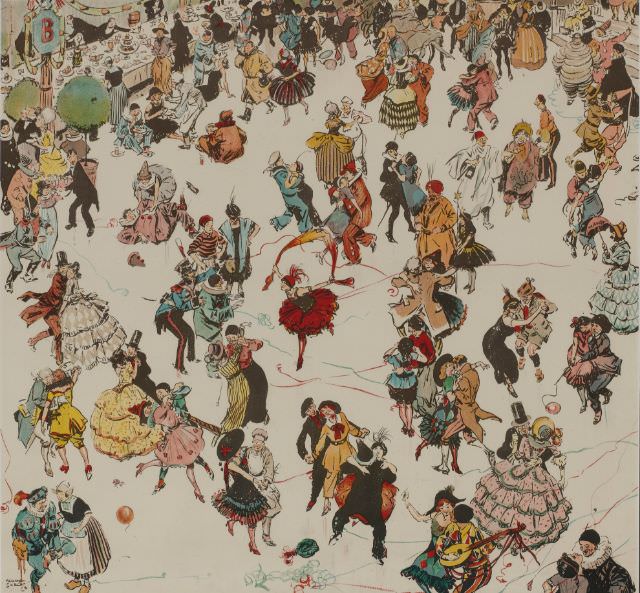
A whirl of satin, feathers, masks, and mischievous grins fills the page in this scene titled “Fancy Dress,” from “Humours of London.” The artist arranges a bustling crowd across an open background, letting the costumes do the heavy lifting: striped tights and layered skirts, capes and bonnets, harlequin diamonds, and theatrical ruffs mingle in a lively tangle. Every figure seems caught mid-gesture—dancing, chatting, flirting, or strutting—so the composition reads like a snapshot of an evening where no one wants to be ordinary.
Across the floor, streamers and ribbons loop and trail like evidence of music and movement, guiding the eye between pairs and small clusters. Fashion becomes performance here, not simply clothing but a kind of social language, with exaggerated silhouettes and playful details hinting at comedy, satire, and the delight of reinvention. Even without a fixed setting, the crowd’s energy suggests a public entertainment—part party, part parade—where watching others is as important as being seen.
Within the broader idea of “Humours of London,” the print works as a witty portrait of urban life, spotlighting the city’s appetite for spectacle and costume. It’s an artwork rich in period style and visual storytelling, perfect for readers interested in historical illustration, London social scenes, and the history of fancy dress. Look closely and the charm multiplies: each tiny character feels like a short story, inviting you to linger and imagine the conversations behind the masks.