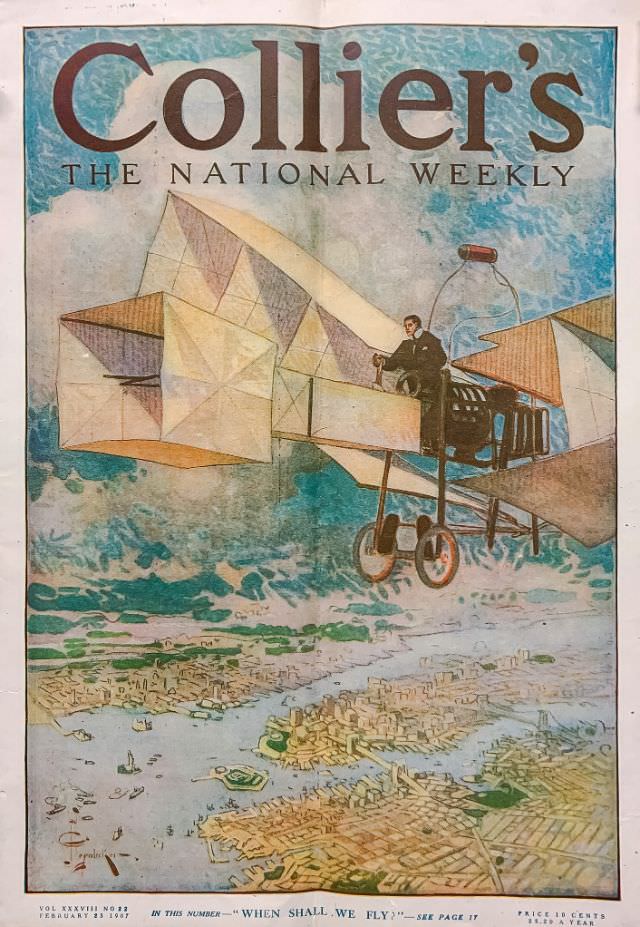
Collier’s magazine greets readers on February 23, 1907 with a bold promise of modernity, its masthead floating above a painted panorama of sea and city. The cover artwork pairs crisp typography—“The National Weekly”—with expansive color washes that evoke height, wind, and motion, drawing the eye from the clouds down to a busy shoreline and clustered rooftops below.
At the center, an early flying machine dominates the scene, all angular wings and exposed framework, piloted by a solitary figure perched high above the water. The illustrator leans into the era’s fascination with invention: delicate planes overlap like folded paper, while the craft’s spindly wheels and struts suggest a world still figuring out how flight should look, much less how it should feel.
Down near the bottom margin, the teaser line “When Shall We Fly?” anchors the image in the public imagination of the time, when aviation hovered between experiment and expectation. For collectors of Collier’s covers, early 20th-century magazine art, and the history of flight in popular culture, this issue offers a vivid snapshot of how mainstream print media sold the future—one thrilling, precarious ascent at a time.