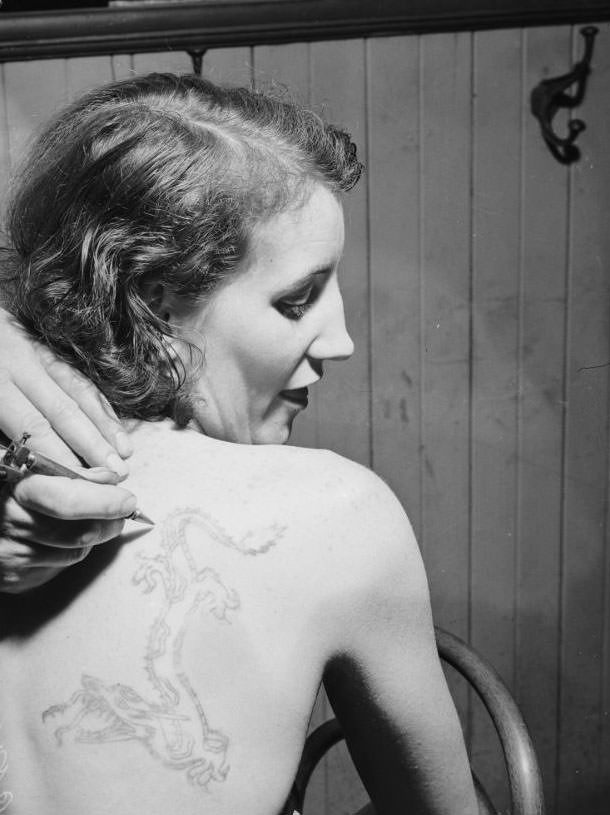
Leaned forward on a simple chair, a woman turns her face in profile as an artist’s hand works at the top of her shoulder blade, the tattoo machine poised with quiet precision. The dragon design—lightly outlined and mid-formation—winds across her upper back, its sinuous body and stylised head emerging as a bold statement against bare skin. Behind her, timber wall panels and hanging hooks create a plain, workshop-like setting that keeps the viewer’s attention fixed on the intimate act of making art.
Dated 17 December 1937 in Sydney, the photograph sits at a fascinating crossroads of body art and social history, when tattoos were far less common in polite public conversation than they are today. The subject’s calm, almost conversational expression hints at choice and confidence, while the visible equipment reminds us that tattooing was already a practiced craft with its own tools, techniques, and routines. Even without additional context, the scene reads as a small moment of modernity: personal identity being inked into permanence.
For readers interested in Australian photography, women’s fashion and self-presentation, or the early story of tattoo culture, this image offers a compelling window into the period. It invites questions about who sought tattoos, how designs like dragons circulated through popular art, and what it meant to wear such imagery on the body in the late 1930s. As part of an “Artworks” theme, the photo underscores tattooing as lived artistry—drawn, endured, and carried into everyday life.