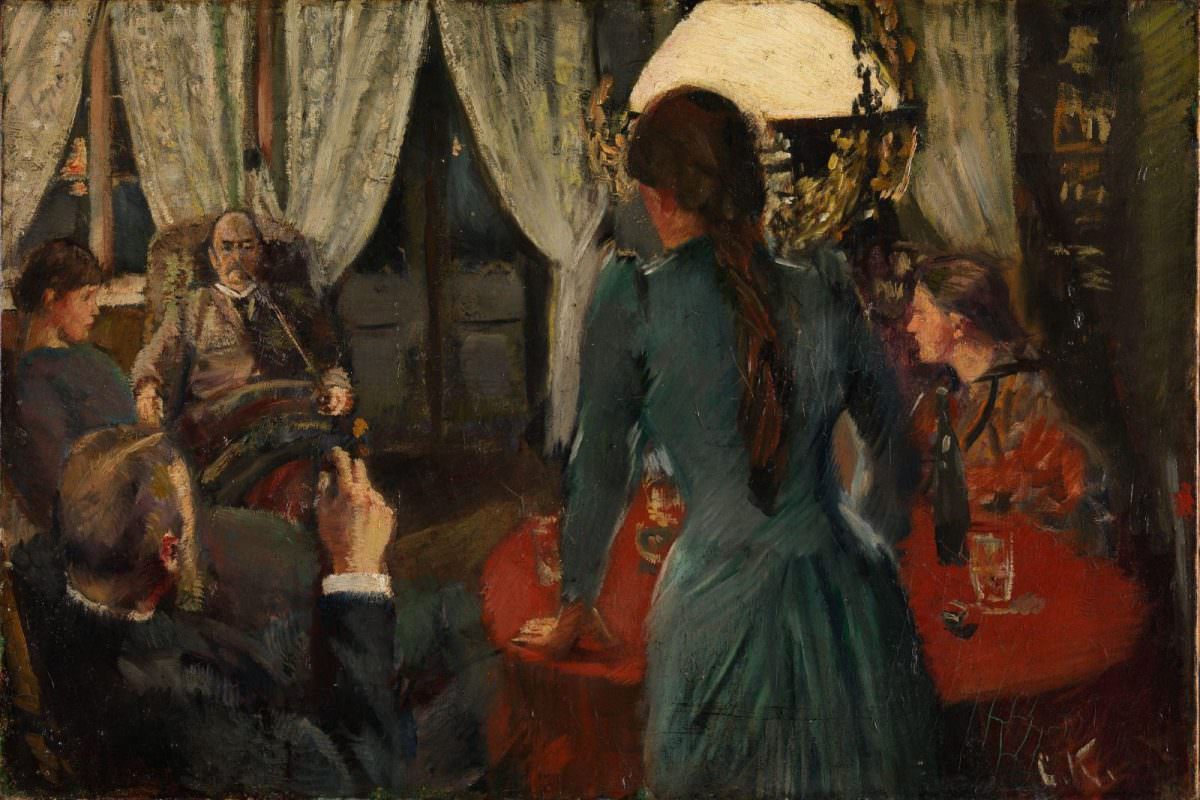
Warm lamplight and heavy drapery set the tone in “After the ‘Løkken’, 1889,” where a late-evening gathering unfolds around a crowded table. A woman in a deep green dress dominates the foreground, her back turned as if she has just risen to speak or to pour another drink, while others lean in from the edges—faces half-caught in shadow, attention fixed on the moment. The palette of reds, browns, and muted greens gives the scene a lived-in intimacy, suggesting conversation, laughter, and the slow unwinding that follows an event.
Across the room, an older gentleman sits back in an upholstered chair, composed and observant, framed by curtains that soften the background into a hush. Glasses and small objects on the table catch highlights, anchoring the composition in everyday ritual: a toast, a shared story, the polite pause between remarks. The title’s reference to “Løkken” hints at something that has just ended—a dance, a round of music, or a social set—leaving behind the afterglow of company and the subtle rearrangement of roles as the night continues.
Seen today, the artwork works as a window into late-19th-century social life, where interiors were stages and etiquette played out in close quarters. Brushwork remains loose and suggestive, inviting the viewer to supply the missing words and to imagine the soundscape beyond the frame. For readers searching for 1889 art, historical genre scenes, and evocative interior painting, this post offers a rich, atmospheric study of how people gathered, watched one another, and made meaning in the small hours after the main event.