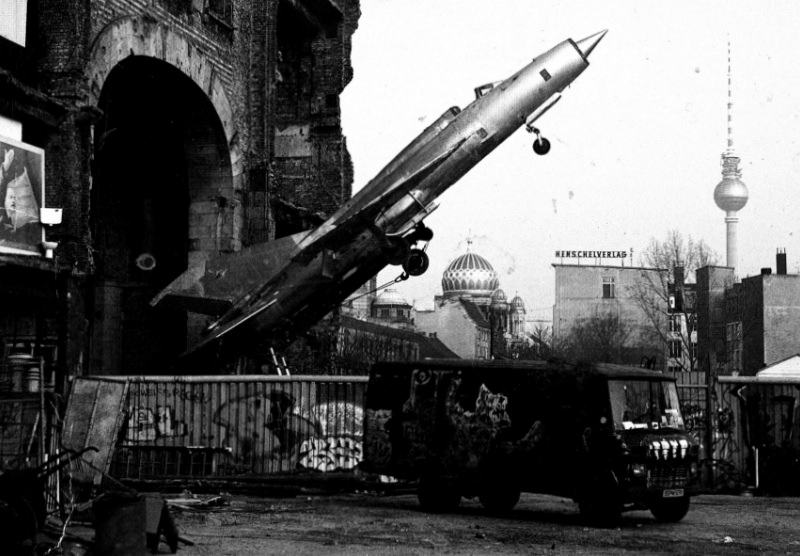
Jagged brickwork frames an impossible sight: a fighter jet pitched nose-up like a launch in progress, wedged into a rough urban lot where rusted metal and rubble gather at the margins. The scene reads like industrial theatre—machinery turned into spectacle—while a boxy vehicle and battered fencing anchor the moment in everyday street grit. In the distance, a distinctive sphere-topped tower punctuates the skyline, lending the installation a sense of scale and placing this act of scrap-born imagination right in the public eye.
Mutoid Waste Company’s 1980s artworks thrived on that collision between discarded transportation and provocative art, and the photograph leans into their signature mood of post-industrial surrealism. Reassembled car parts and salvaged hardware become more than junk; they become a statement about consumption, militarism, and the aesthetics of decay, staged where passersby can’t avoid it. The stark monochrome emphasizes hard edges, scorched textures, and improvised engineering—details that make the piece feel both playful and unsettling.
For readers searching the history of Mutoid Waste Company or the wider story of 1980s scrap metal sculpture, this image offers a vivid doorway into a scene that treated the street as a gallery and the scrapyard as a studio. It suggests an era when reclaimed car parts, welded assemblage, and found-object installations could hijack a city backdrop and turn it into a set for darkly comic futurism. The result is bizarre, bold, and strangely alive—an artwork that looks ready to move even while it’s frozen in steel.