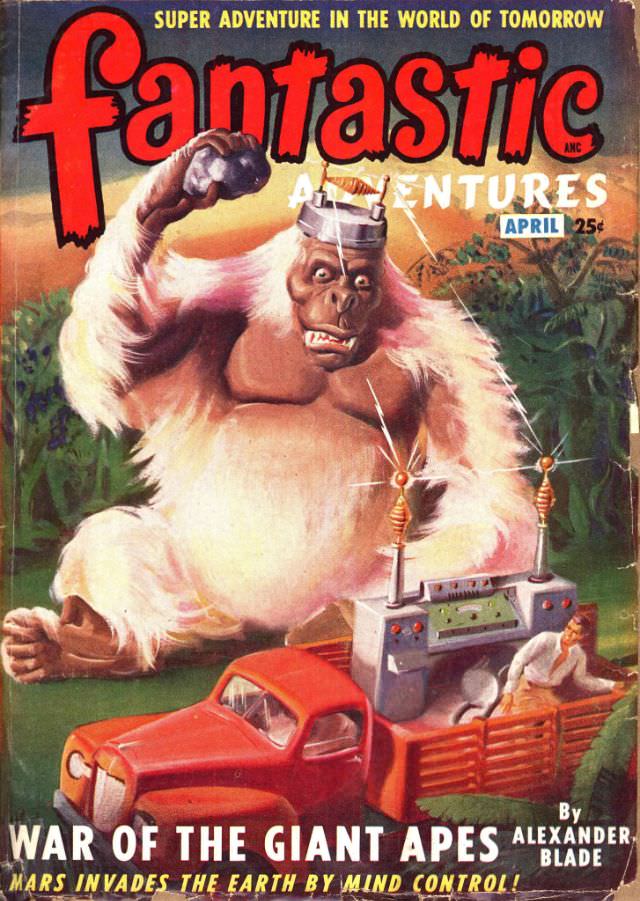
Bold, pulpy lettering shouts “Fantastic Adventures” across the top, promising a “super adventure in the world of tomorrow” and anchoring the cover in the exuberant visual language of mid-century science fiction. The April issue marker and “25¢” price tag sit beside the masthead, a small detail that instantly evokes the newsstand era when colorful genre magazines fought for attention with a few square inches of dramatic art.
At the center, a towering white-furred ape dominates a jungle-like setting, its raised fist frozen in a moment of imminent violence while an odd, helmet-like device suggests the intrusion of technology into the wild. Below, a bright red truck hauls a boxy machine bristling with antennae and sparking nodes, with a tiny human figure nearby to emphasize the creature’s colossal scale and the story’s stakes. The composition leans hard into contrast—organic foliage against hard-edged machinery, primal strength against futuristic gadgetry—creating the kind of instant, cinematic conflict that defined classic pulp cover art.
“War of the Giant Apes” blares from the bottom in big type, reinforced by the breathless teaser “Mars invades the earth by mind control!” and a byline credit to Alexander Blade. Even without turning a page, the illustration sells a full narrative: invasion, strange science, and humans scrambling under an oversized threat. For collectors and fans of vintage sci-fi magazine covers, this artwork is a vivid snapshot of how 1940s popular imagination pictured tomorrow—loud, lurid, and irresistibly adventurous.