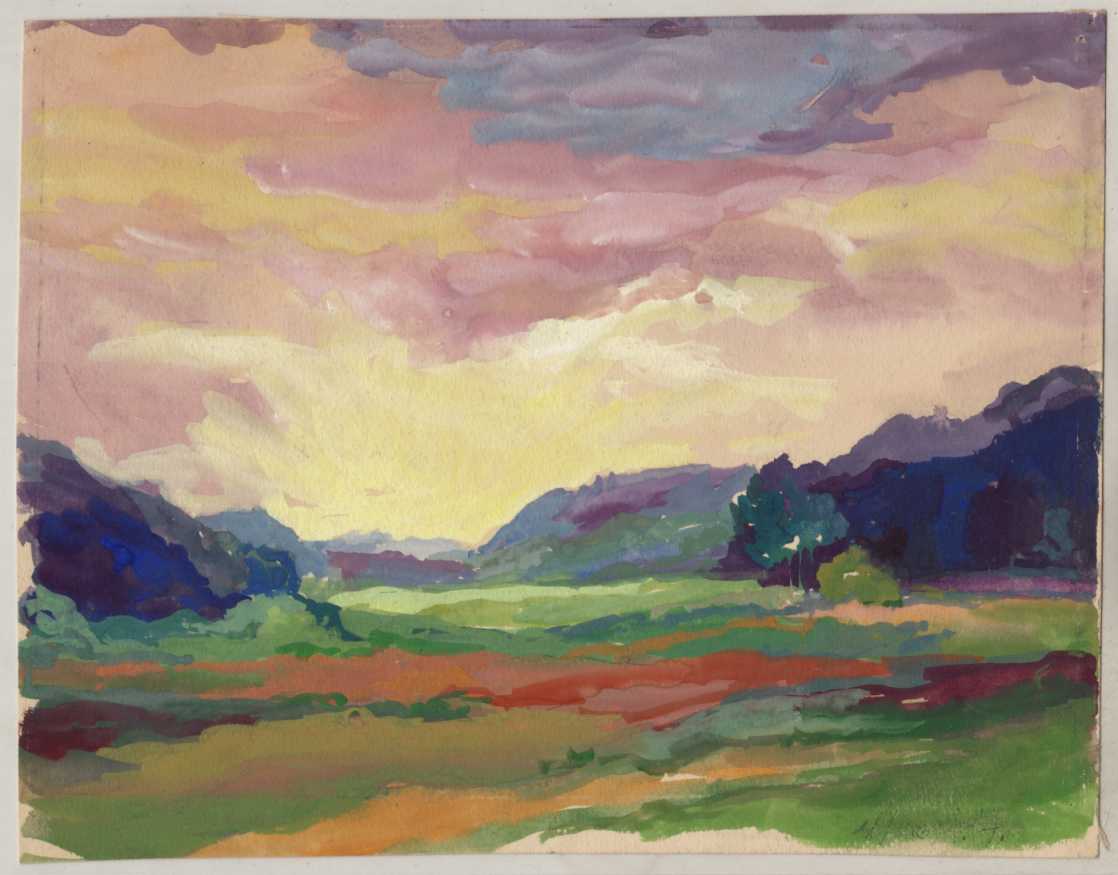
Soft bands of color stretch across the landscape in “Rolling Hills,” where broad fields and distant ridgelines settle into a calm, layered horizon. The foreground reads like worked land—patches of green and earth tones laid in wide strokes—while the middle distance opens into a pale valley that draws the eye inward. Above it all, a luminous sky shifts from warm yellows to mauves and cool blues, suggesting changing weather and late-day light without pinning the scene to a specific place.
Rather than fuss over tiny details, the artist leans on simple shapes and confident washes to evoke atmosphere: shadowed tree masses on either side frame the view, and the hills recede in softened, bluish planes. The composition feels pastoral and unhurried, a study in how countryside light can turn familiar terrain into something quietly dramatic. Even the visible paper edges contribute to the sense of an artwork made to capture an impression quickly, before the colors of the sky moved on.
For readers interested in historical landscape art, this piece offers a vivid example of how painters translated rural scenery into expressive color and rhythm. Its rolling contours and open farmland create strong search appeal for themes like vintage countryside painting, rolling hills artwork, and pastoral landscape study. Whether you come for the serene fields or the sky’s shifting palette, the scene invites a slow look and a moment of stillness.