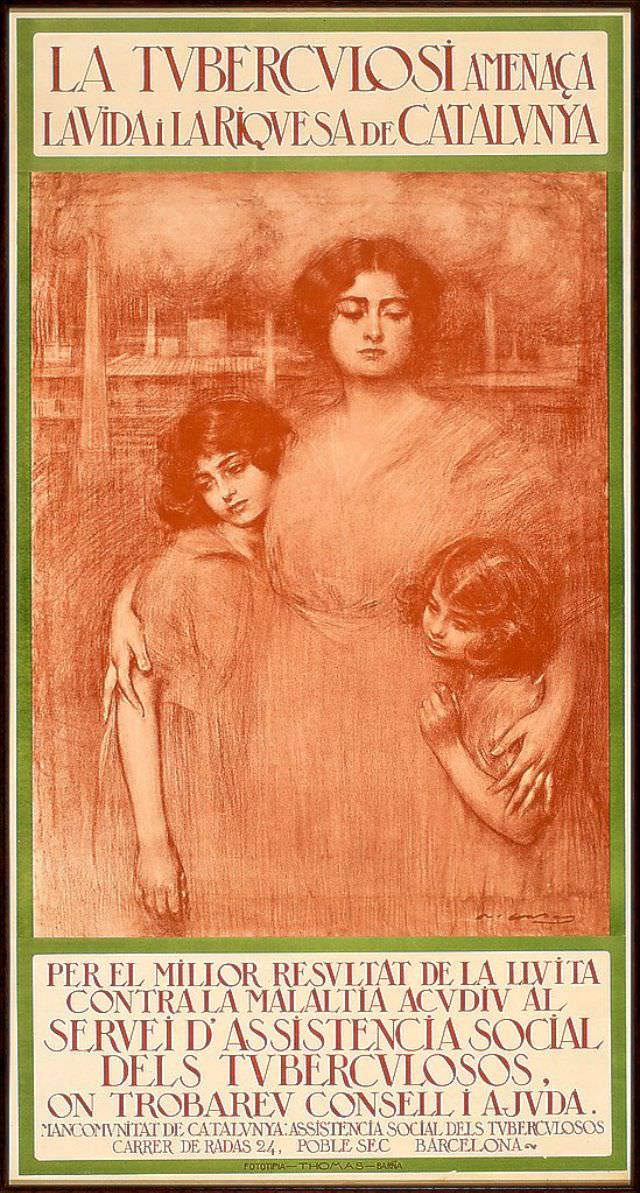
Across the top, a stark Catalan warning—“La tuberculosi amenaça la vida i la riquesa de Catalunya”—frames the poster’s purpose with unmistakable urgency. Rendered in warm sepia tones and bordered in green, the composition draws the eye to a central figure whose closed eyes and heavy stillness suggest exhaustion and anxiety, while two children cling to her for comfort. The soft, sketch-like treatment gives the scene a hushed intimacy, turning public health messaging into a domestic drama.
More than an artwork, this circa-1910s anti-tuberculosis poster reveals how early twentieth-century campaigns appealed to both compassion and civic responsibility. By pairing the language of “life” and “wealth,” it argues that disease threatened families and the broader prosperity of Catalonia, linking personal suffering to social consequence. The mother-and-children motif reinforces what was at stake: the household, the next generation, and the fabric of everyday life.
At the bottom, the text invites readers to seek “consell i ajuda” through a social assistance service for tuberculosis sufferers, pointing to organized support rather than private despair. For historians, collectors, and anyone interested in Catalan history, public health, or medical propaganda, the poster offers a vivid snapshot of how communities mobilized before modern antibiotics transformed the fight against TB. Its blend of persuasive typography and emotional illustration makes it an enduring piece of historical health communication and Catalonia heritage.