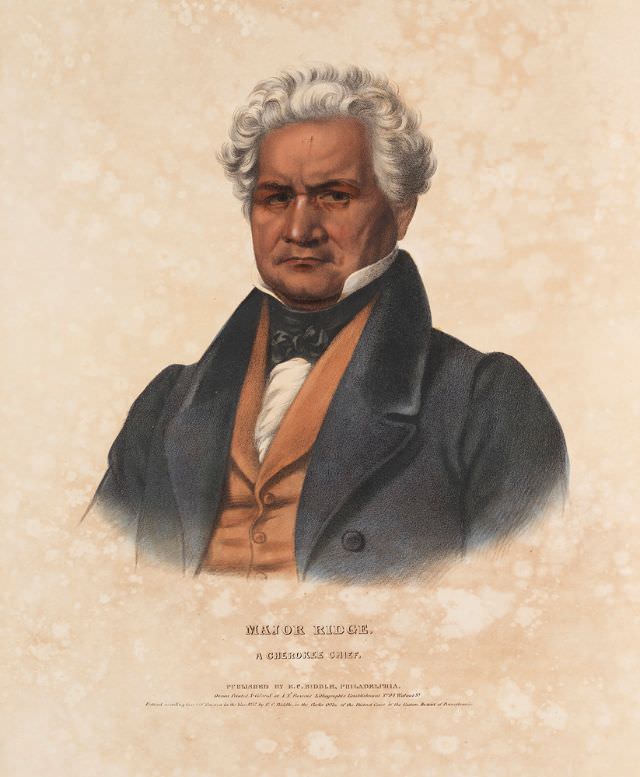
Major Ridge appears here in a formal portrait that reads as both artwork and historical record, presenting a Cherokee chief with a steady, unsmiling gaze. The artist emphasizes dignity through careful detail—silvered hair, a strong brow, and the composed posture of someone accustomed to being heard. His tailored coat, high collar, and layered waistcoat reflect the era’s public-facing style, suggesting how Indigenous leaders were often depicted for audiences beyond their own communities.
Beneath the portrait, the printed caption “MAJOR RIDGE. A CHEROKEE CHIEF.” anchors the image as a titled print meant for circulation and reference. The soft, warm background keeps attention on the face, while the crisp outlines of clothing and shadow lend the figure a sculpted presence. As an example of early American portrait art, it offers a window into how Native American leadership was framed in popular visual culture.
For readers searching for Major Ridge, Cherokee history, or Native American portraits, this piece invites reflection on representation as much as remembrance. It preserves the likeness of a prominent Cherokee figure in a style that blends respect, formality, and the conventions of period portraiture. Whether you approach it as genealogy, art history, or Indigenous history, the image rewards a slower look at what it chooses to highlight—and what it leaves unsaid.