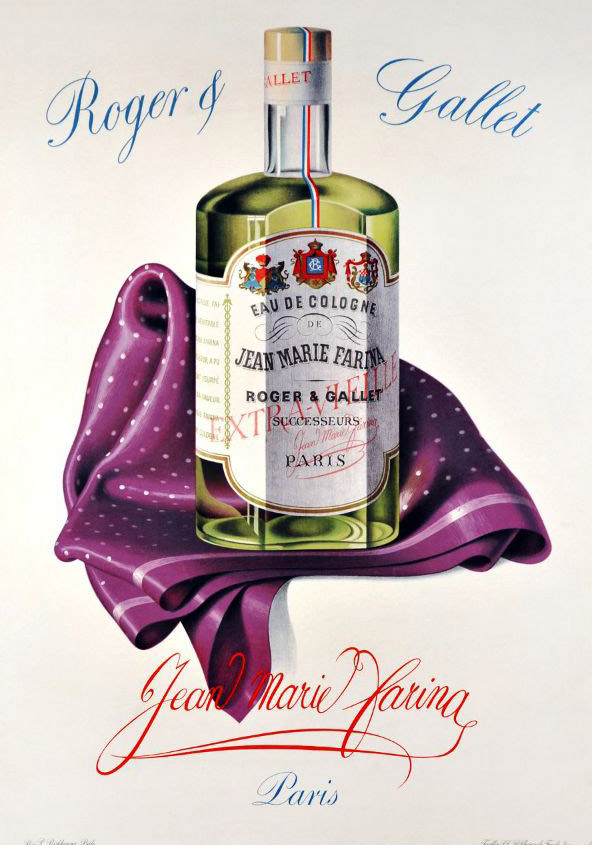
Elegance is distilled into a single object here: a Roger & Gallet bottle of Eau de Cologne Jean-Marie Farina, rendered with the crisp polish of a 1942 advertisement. The green glass sits upright and luminous against a pale background, its label packed with heraldic flourishes, fine typography, and a tricolor ribbon detail that draws the eye down the neck. Below, sweeping calligraphy—“Jean Marie Farina” and “Paris”—turns the brand name into a signature, as if the scent itself were a personal letter.
Draped beneath the bottle, a rich purple scarf with tiny white dots introduces softness and movement, a theatrical prop that suggests touch, fabric, and the private ritual of getting ready. The composition balances precision and sensuality: hard reflections on glass, crisp edges on the label, then folds of cloth that pool and curl like stage curtains. Even without depicting a person, the design evokes a refined world of dressing tables, travel cases, and the small luxuries of grooming.
Viewed today, this piece reads as both artwork and marketing—an example of how mid-century commercial illustration sold not only a product but an aspiration. For readers interested in perfume history, French fragrance branding, or Roger & Gallet ephemera, the image offers an immediately recognizable visual language: crests, scripts, and the promise of Parisian sophistication. It’s a compact, memorable snapshot of how Eau de Cologne Jean-Marie Farina de Roger Gallet presented itself in 1942, poised between tradition and modern style.