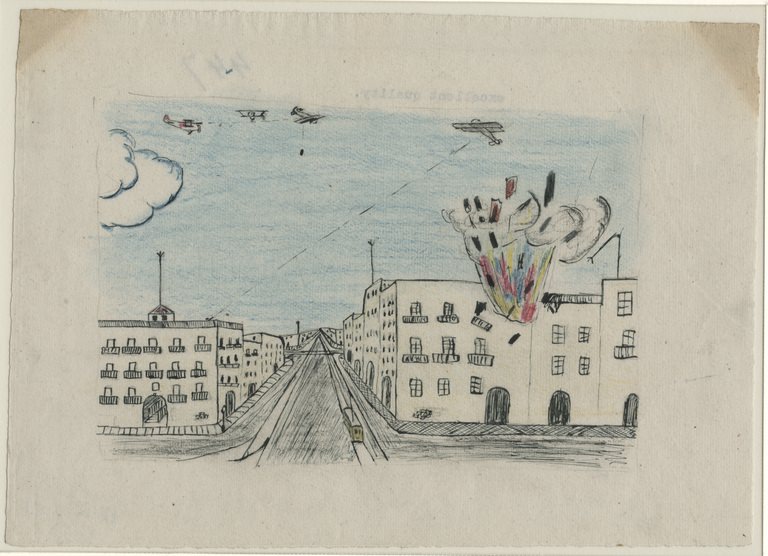
Luis Villar Baladrón, only 11 years old in Bellús, offers a striking child’s-eye view of a town interrupted by modern peril and imagination. A broad roadway or bridge slices into the distance between simple block-like buildings, while small aircraft drift across a pale blue sky. On the right, an erupting burst of color and debris suggests an explosion, rendered with expressive strokes that stand out against the otherwise restrained lines.
Drawn with confident pencil outlines and light washes, the scene balances everyday architecture—rows of windows, arched doorways, and a calm street—with sudden motion overhead. The clouds curl in soft shapes, and dashed marks hint at trajectories, guiding the viewer’s gaze from the planes to the dramatic blast. The contrast between careful city details and the chaotic flare evokes wartime imagery without pinning it to a specific event.
As an artwork attributed in the title to a young artist, this piece invites readers to think about how children processed the wider world through drawing, especially when news and fear traveled faster than certainty. For anyone searching for “Luis Villar Baladrón Bellús 11 años” or exploring Spanish historical drawings, youth perspectives, and memory in art, the image becomes both document and testimony. It’s a reminder that even simple lines on paper can preserve a community’s atmosphere—its streets, its skyline, and the stories that might have hovered above them.