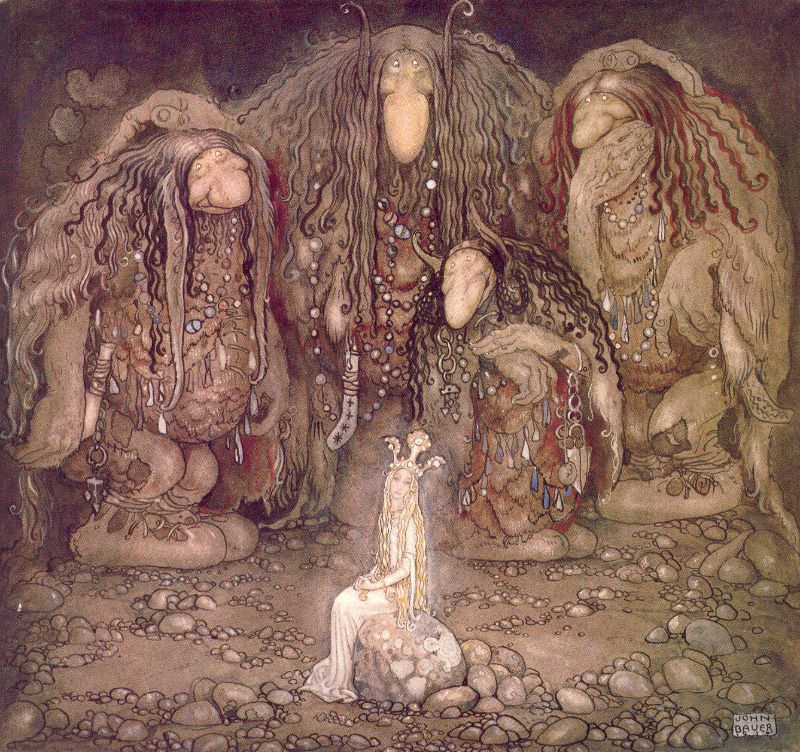
Beneath a dim, earthy sky, a small princess sits on a rounded stone like a pale candle in a cavern, her long hair falling in soft strands and her crown rising in delicate points. Around her, the ground is strewn with pebbles and uneven rocks, a texture that makes the scene feel half-real and half-dreamed. The contrast between her calm posture and the heavy, shadowed surroundings sets an immediate fairy-tale tension that lingers in the eye.
Towering behind her are trolls rendered with exaggeration and care: long curtain-like hair, broad noses, and bead-laden adornments that glint as if scavenged from countless stories. Their bulky bodies and slumped stances form a protective—or possibly imprisoning—ring, while their faces tilt in different directions, suggesting curiosity, suspicion, and a slow, unsettling attention. Muted browns and smoky violets dominate the palette, yet the princess remains the brightest focal point, emphasizing vulnerability amid looming folklore.
Dated 1915, “Trolls and princess” belongs to an era when illustrators and artists across Europe and beyond were revisiting myths, nursery tales, and the darker corners of fantasy with refined decorative detail. The work’s meticulous line and patterned jewelry invite close viewing, rewarding readers who love early 20th-century illustration, fairy-tale art, and historical fantasy imagery. For WordPress archives and art-history searches alike, it’s a striking example of how folklore was visualized in the early modern age—mysterious, intimate, and quietly unsettling.