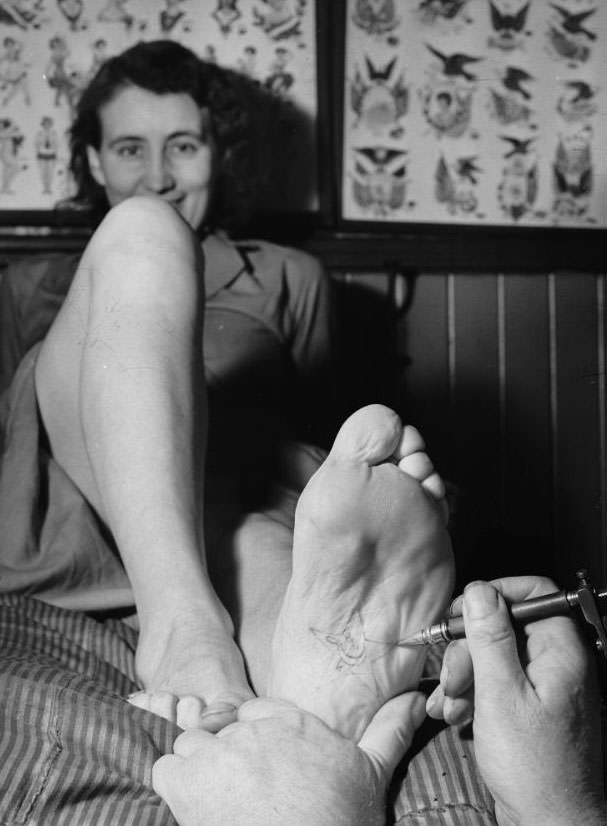
A client reclines with a bare foot extended toward the camera while a tattooist’s hands steady the heel and guide the buzzing machine into place. The focus falls on the sole, where the first lines of a small design are being worked in, giving a rare, intimate view of technique and trust inside Fred Harris Tattoo Studio in Sydney. Behind the chair, flash sheets cover the wall with birds, emblems, and other classic motifs, situating this moment squarely in the visual culture of 1930s tattooing.
The post title highlights the hammer and sickle, and that choice of symbol carries an edge that goes beyond decoration. In 1937—when political ideologies were intensely debated—wearing such an emblem on the body could be read as identity, defiance, or simply fascination with bold graphic marks. Even without seeing the finished ink, the photograph invites readers to consider how tattoo art, personal politics, and modern self-fashioning intersected in pre-war Australia.
Sydney’s tattoo history often survives in shop names, surviving flash, and a scattering of candid studio photographs like this one, which captures not only a design but an atmosphere. The casual smile of the client, the close-up viewpoint, and the dense backdrop of wall art combine to document a working studio rather than a staged portrait. For anyone searching for historical tattoo photos, Fred Harris Tattoo Studio, or Australian body art in 1937, this image offers a vivid window into everyday practice and the stories people chose to carry on their skin.