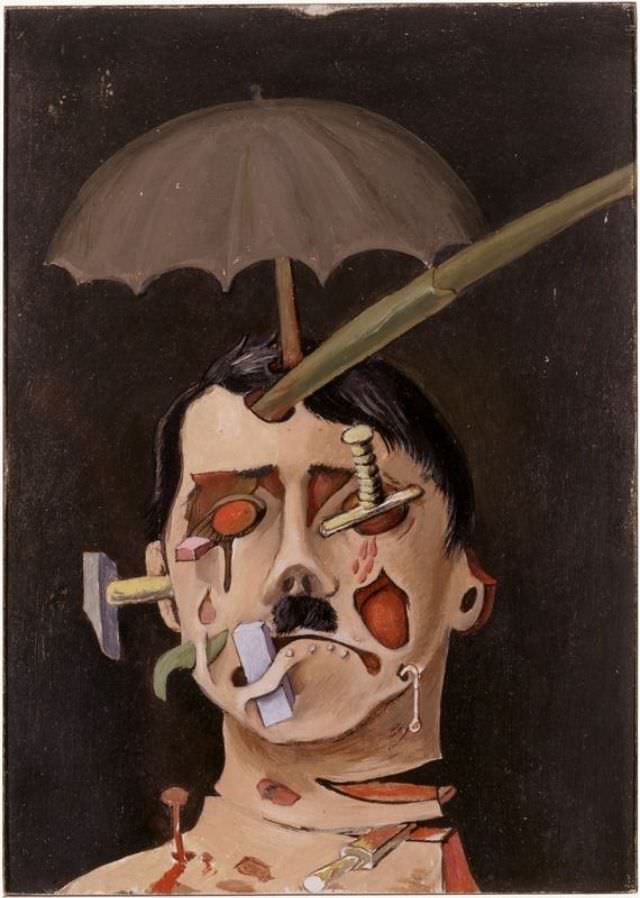
Brauner’s 1934 portrait of Adolf Hitler is less a likeness than a dismantling, presenting a battered head against a deep, empty background. The face is pierced, taped, and punctured—an umbrella floats overhead while a long, greenish form juts across the forehead, and metal-like fragments and pins seem to fasten the features in place. Stark lighting and a limited palette intensify the sense of damage, turning skin into a surface for marks, wounds, and crude repairs.
Surrealist strategies drive the composition: everyday objects become instruments of violence, and the familiar moustached profile is transformed into a grotesque assemblage. Blood-red accents, exposed patches, and dangling drips create a visceral rhythm across the cheeks and mouth, while the eyes read as altered or obstructed rather than expressive. The overall effect is deliberately unsettling, pushing the viewer to confront the figure as a constructed icon—and then watch that icon come apart.
In the context of 1930s European art, works like this are often discussed for how they respond to propaganda, power, and the cult of personality through distortion and satire. For readers searching for Brauner’s portrait of Hitler (1934), surrealism, political art, or anti-fascist imagery, the piece stands as a striking example of how artists used allegory and shock to challenge authoritarian mythmaking. It remains a compelling artifact not because it flatters its subject, but because it exposes the fragility beneath the manufactured image.