Category: Colorization
See history come to life with colorized photographs of the past. From wars to daily life, these restored images bridge time with emotion and realism.
Each colorized photo revives forgotten stories and gives a fresh perspective on iconic historical moments.
-

#6 Chief Little Wound And Family. Oglala Lakota. 1899. Photo By Heyn Photo
Quiet authority radiates from this 1899 studio portrait of Chief Little Wound and family of the Oglala Lakota, photographed by Heyn Photo and later colorized. The careful pose—one figure seated with a steady gaze, another standing behind, and a third seated at the front—creates a sense of closeness and shared presence, as if the photographer…
-
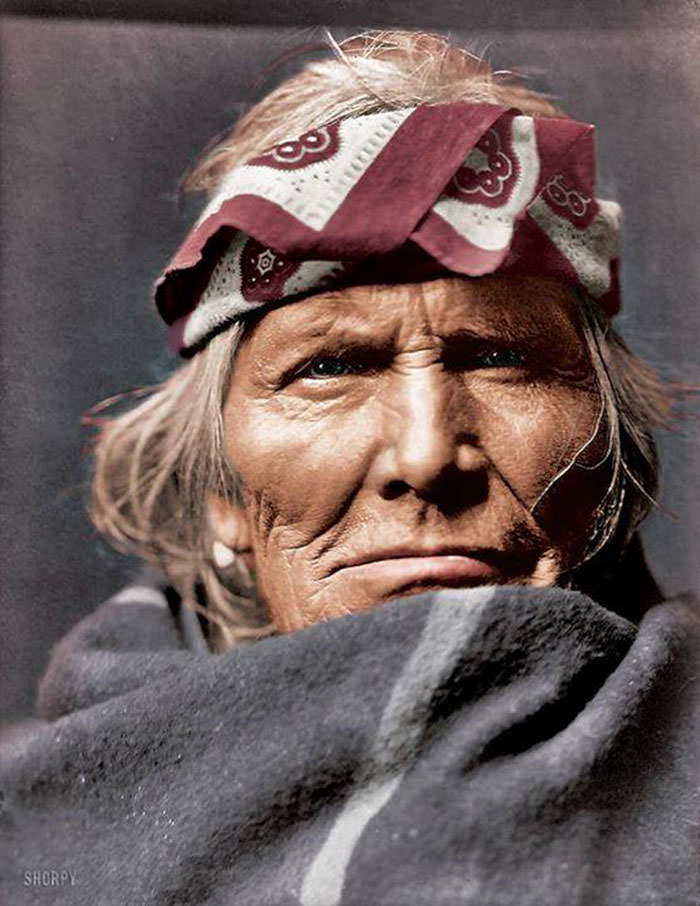
#22 Si Wa Wata Wa. A Zuni Elder. New Mexico. 1903. Photo By Edward S. Curtis
Weathered lines and a steady, unsmiling gaze make Si Wa Wata Wa feel close across the century, an elder of the Zuni people photographed in New Mexico in 1903. The portrait is tightly framed, drawing attention to the patterned headscarf and the soft fall of gray hair, while a heavy blanket wraps the shoulders in…
-

#38 Chief Hollow Horn Bear. Sicangu Lakota. 1905. Photo By Delancey W. Gill
In profile, Chief Hollow Horn Bear of the Sicangu (Brulé) Lakota is presented with a calm, resolute presence, his gaze set beyond the frame. The colorized portrait brings out the layered textures of regalia—soft white featherwork, beadwork at the brow, and long ribbons that fall against a richly toned garment—inviting the viewer to linger over…
-
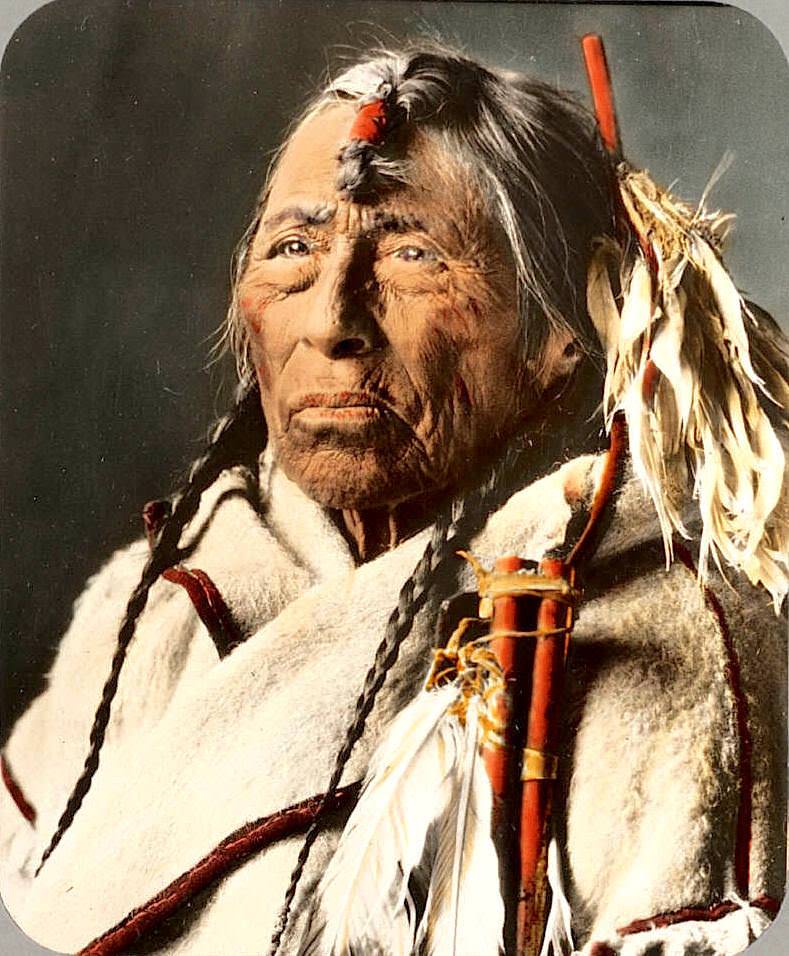
#54 Eagle Arrow. A Siksika man. Montana. Early 1900s. Glass lantern slide by Walter McClintock.
Eagle Arrow meets the viewer with a steady, unsentimental gaze, rendered with the quiet intensity that glass lantern slides can preserve. The colorization brings forward the warmth of skin tones, the silvery strands of hair, and the soft heft of a wool blanket wrapped close against the body. Set against a dark, simple backdrop, the…
-

#14 Pjotr Iljitsch Tschaikowski
Pjotr Iljitsch Tschaikowski appears here in a formal studio portrait, posed with the quiet self-command of a celebrated composer. The carefully trimmed beard, receding hairline, and direct, slightly distant gaze lend the face a contemplative gravity, while the plain backdrop keeps all attention on expression and posture. A dark, double-breasted coat, crisp white collar, and…
-

#30 Buffalo Bill, 1906
Buffalo Bill stands with an easy authority on a front step framed by tall, classical columns, his dark hat and long overcoat cutting a sharp silhouette against pale stone. The colorization draws the eye to small, human details—the winter light in the glass behind him, the trim of his white mustache and goatee, and the…
-
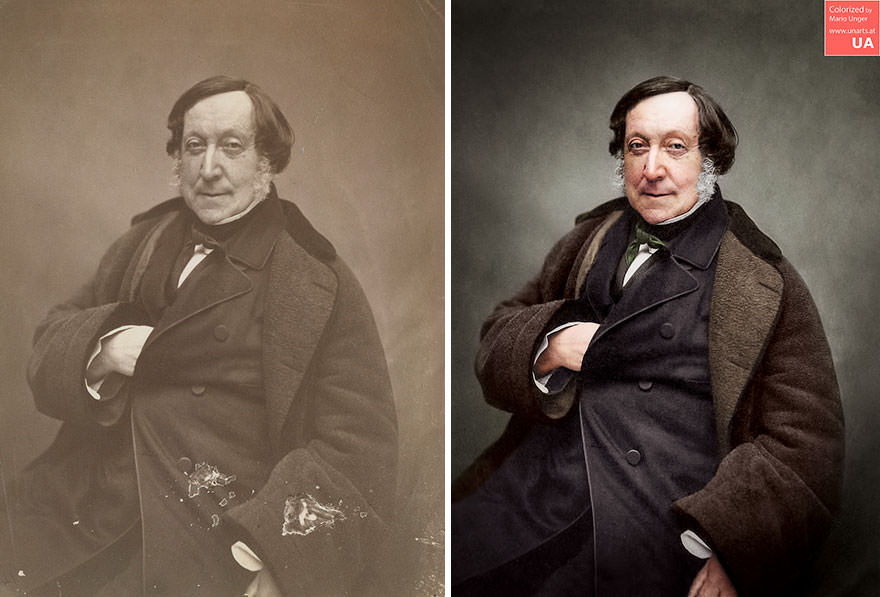
#46 Gioacchino Rossini, 1856
Gioacchino Rossini appears here in a late-life studio portrait dated 1856, seated and turned slightly toward the viewer with an expression that feels both reserved and alert. His heavy overcoat, neatly fastened layers, and carefully arranged cravat speak to mid-19th-century formality, while the relaxed placement of his arms gives the pose an unforced, almost conversational…
-

#62 Admiral David Dixon Porter, 1860
Admiral David Dixon Porter appears here in a formal studio pose, turned slightly to the side as if caught in thought rather than performance. The colorization draws the eye immediately to his striking red beard and the quiet intensity of his gaze, giving a vivid sense of personality that older monochrome reproductions can soften. Set…
-

#6 Iola Swinnerton and Anna Neibel, winners of a beauty contest at Washington’s Tidal Bathing Beach, 1922.
Caught in a celebratory pause, Iola Swinnerton and Anna Neibel stand side by side with polished trophy cups in hand, fresh from a beauty contest at Washington’s Tidal Bathing Beach in 1922. Their confident stances and direct gazes feel modern, yet the details—cloche-style caps, knee-high stockings, and practical bathing shoes—anchor the moment firmly in the…
-

#10 S. A. S. le Prince Dmitri Galitzine, Chef de la Venerie Imperial
Commanding attention in full ceremonial dress, Prince Dmitri Galitzine stands poised as “Chef de la Venerie Imperial,” a title that evokes the courtly world of imperial hunting and ritual. The colorization brings an immediacy to the portrait: deep crimson velvet, a dark fur hat, and a controlled, formal stance that speaks to rank as much…