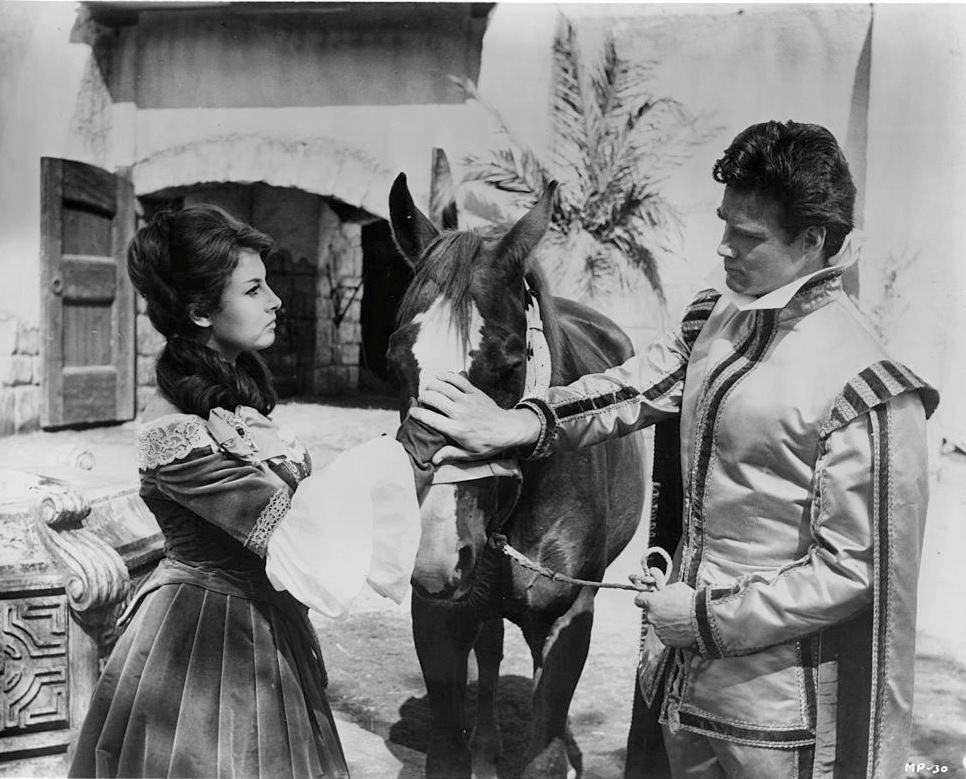
Between a sunlit courtyard and a patient horse, Steve Reeves and Valérie Lagrange meet in a quiet, tense moment from *Morgan The Pirate* (1960). Reeves, dressed in an ornate period costume, steadies the reins while studying Lagrange’s face; she stands poised with her hands held close, her lace-trimmed sleeves and fitted gown suggesting status as much as vulnerability. The architecture behind them—arched stonework and an open doorway—frames the scene like a stage, lending the still a sense of story just about to turn.
The photograph’s charm lies in what it doesn’t shout: no sword raised, no battle smoke, just two stars caught in character, letting expression carry the drama. Reeves’ larger-than-life screen presence reads in the confident stance and tailored doublet, while Lagrange’s profile and carefully styled hair evoke the romantic intrigue that often threads through classic swashbucklers. Even the horse becomes part of the composition, a grounded, almost intimate prop that hints at travel, pursuit, and escape without spelling it out.
As a piece of 1960s cinema ephemera, this promotional-style still speaks to the era’s appetite for historical adventure films—lavish costumes, exotic atmospheres, and charismatic leads. Fans searching for Steve Reeves photos, Valérie Lagrange images, or *Morgan The Pirate* (1960) will appreciate how the scene balances spectacle with restraint, inviting closer inspection of fabric textures, set dressing, and body language. It’s a small window into the film’s romantic tension and old-school movie-star mystique, preserved in crisp monochrome.