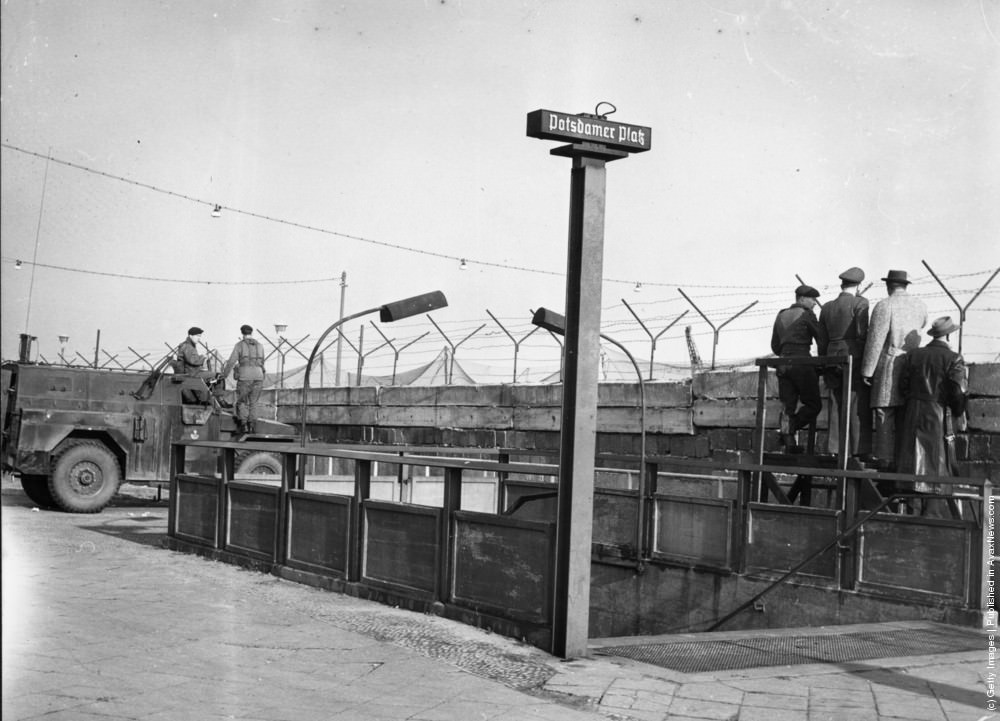
Under the stark “Potsdamer Platz” sign, a subway entrance sits half-swallowed by concrete barriers and a tangle of wire, turning an everyday point of passage into a checkpoint of the Cold War. Soldiers cluster beside a military vehicle while civilians linger on a raised platform, their bodies angled toward the restricted zone as if trying to read the future in a newly sealed border. The scene feels provisional yet uncompromising—streetlamps and paving stones remain ordinary, but the space has been redefined by force.
Circa 1961, Potsdamer Platz became one of Berlin’s most charged thresholds, where movement could be measured in meters and permission. The Berlin Wall’s early form appears here as layered defenses rather than a single monolith: concrete segments, fencing, and watchful presence creating a hard edge across a formerly open urban landscape. Even without dramatic action, the photograph communicates tension through posture and placement—who stands where, who watches, and who is kept back.
What makes the image linger is its plainness: a city corner, public infrastructure, and people going about a constrained routine, all transformed into symbols of division. For readers searching for Berlin Wall history, Potsdamer Platz, or 1961 Cold War photos, this frame offers a grounded look at how borders are built into the fabric of daily life. It’s a reminder that political conflict is often visible not only in grand speeches, but in the altered entrances, blocked streets, and guarded steps of a familiar station.