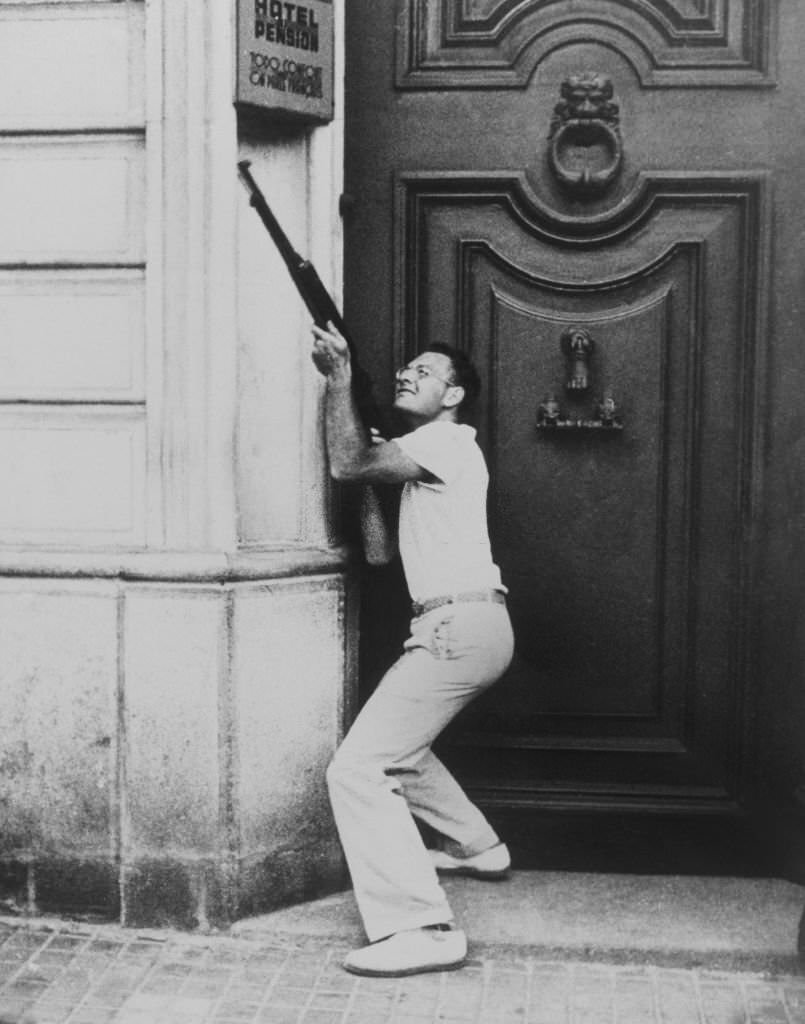
Pressed against an imposing doorway, a civilian raises a long gun toward the street, his body angled for cover while his face turns upward in tense concentration. The heavy carved door and stone façade dwarf him, reminding the viewer how quickly ordinary urban spaces in Barcelona were repurposed into improvised fortifications during the Spanish Civil War. Even small details—like the “Hotel Pensión” sign above—anchor the scene in everyday commerce abruptly interrupted by gunfire.
Dated in the title to July 22nd, 1936, the photograph speaks to the chaotic early days of the conflict, when government-issued weapons and hastily formed militias blurred the line between soldier and citizen. The man’s plain shirt and light trousers suggest no uniform, only urgency, making his stance feel less like battlefield choreography and more like a split-second decision made in a familiar neighborhood. Doorways, corners, and thresholds become tactical positions, and the street beyond the frame becomes an unseen adversary.
For readers searching Spanish Civil War history, Barcelona 1936, or civilian fighters in urban warfare, this image offers a stark, close-up perspective on how political upheaval is lived at street level. It captures the uneasy transformation of daily life into defensive action, where lodging houses and residential entrances serve as shields. Viewed today, the photo stands as a reminder that civil wars are fought not only across front lines, but also in the ordinary architecture of a city and the ordinary bodies compelled to defend it.