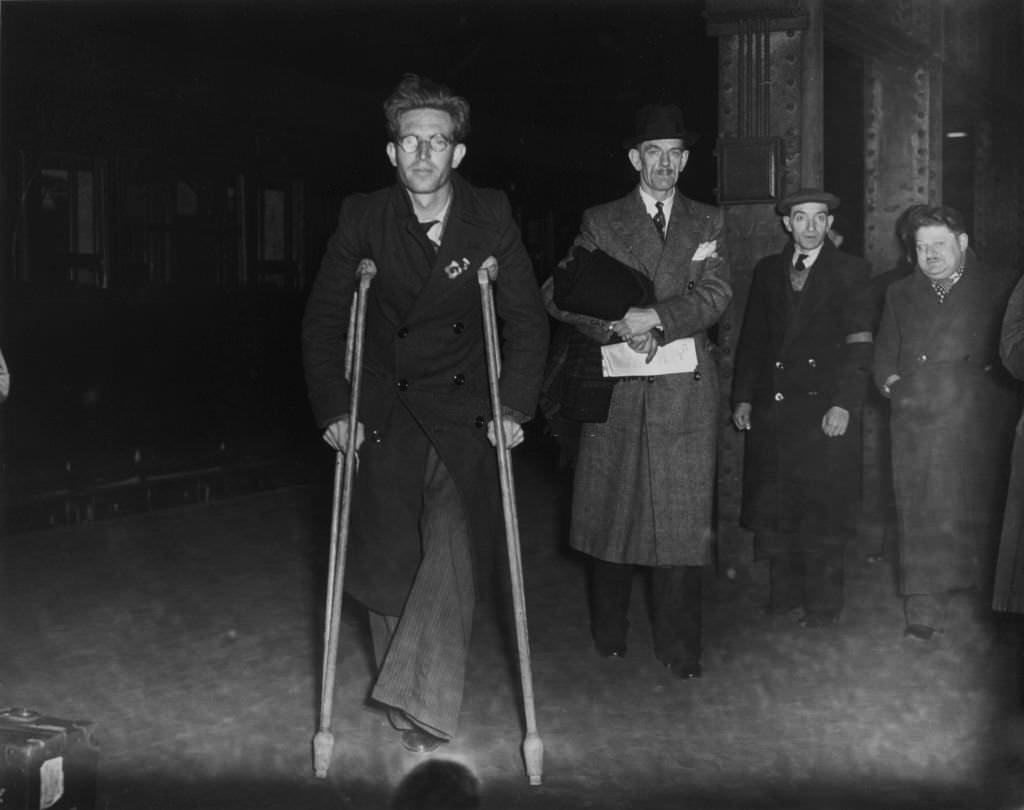
On the dim platform at Victoria Station, a wounded volunteer moves forward on crutches, his overcoat buttoned tight against a London winter and his face set with the fatigue of travel and pain. A small knot of men in heavy coats and hats lingers behind him, watching as he steps into the public gaze—neither triumphant nor anonymous, simply present. The station’s ironwork and shadowed background make the scene feel hushed, as if the city is absorbing the cost of a distant war one returning body at a time.
The title places the moment on 19 December 1938, when members of the International Brigades were coming back from the Spanish Civil War, their idealism tested by trenches, bombardment, and injury. In this frame the details do the work of history: the improvised rhythm of crutches on the ground, the paper held by a companion, the suitcase low at the edge, and the crowded emptiness of a nighttime arrival. It is a reminder that “Civil Wars” are never confined to their front lines; they travel home in scars, silences, and altered lives.
For readers searching the history of the International Brigade in Britain, Victoria Station becomes more than a transport hub—it becomes a threshold between battlefields abroad and the complicated reception awaiting veterans at home. The photograph invites questions about who met these men, how their service was understood in late 1938, and what support existed for those returning wounded. As a historical image for a WordPress post, it offers a stark, SEO-friendly window into the Spanish Civil War’s human aftermath and the London scenes that marked the end of a perilous chapter.