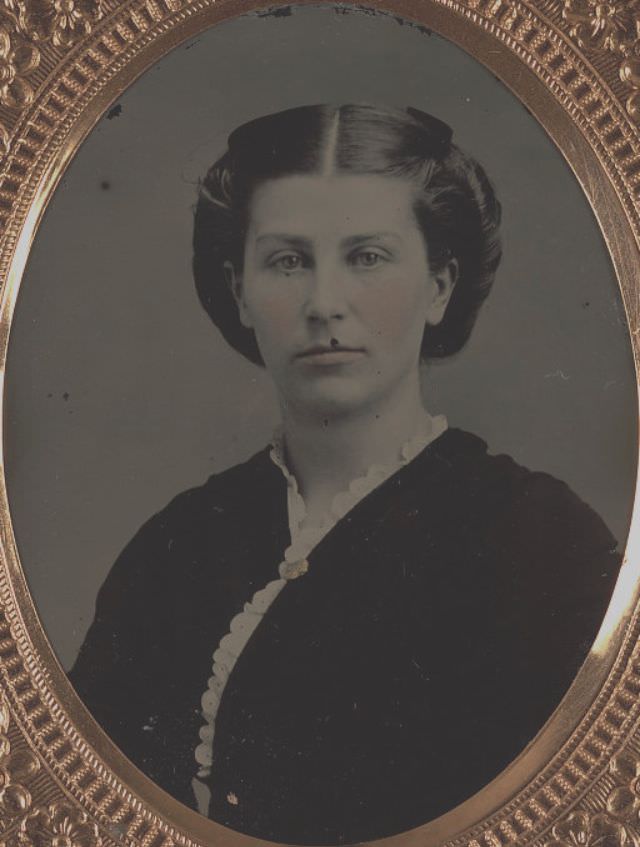
Framed by an ornate oval mat, Nurse Mary A.E. Keen meets the camera with a steady, unsentimental gaze that feels unmistakably of the Civil War era. Her center-parted hair is drawn back in smooth, sculpted rolls, and her dark dress is relieved by a narrow line of light fabric at the collar—small details that speak to the formal studio conventions of the time. The soft focus and careful lighting turn the portrait into something both intimate and official, as if meant to preserve resolve as much as likeness.
The title links this face to wartime hospital work at Seminary Hospital in Washington, D.C., and at Chesapeake Hospital at Fort Monroe, Virginia, placing her within the vast medical network that expanded urgently from 1861 to 1865. Under the jurisdiction of Dorothea Dix, women like Keen navigated strict standards and relentless labor, tending the wounded amid shortages, uncertainty, and the daily arithmetic of survival. Seen with that context, the stillness of the portrait hints at the discipline required of nurses whose service rarely fit neatly into battlefield narratives.
After the war years, the record noted here continues into civilian life, including her later marriage to Milton Woodworth, reminding readers that service did not end with a surrender or a photograph’s final exposure. For anyone researching Civil War nursing, women’s history, or the hospitals of Washington and Fort Monroe, this image offers a compelling entry point—part personal keepsake, part historical document. It invites a closer look at how wartime caregiving shaped lives, and how a single portrait can carry both duty and aftermath in silence.