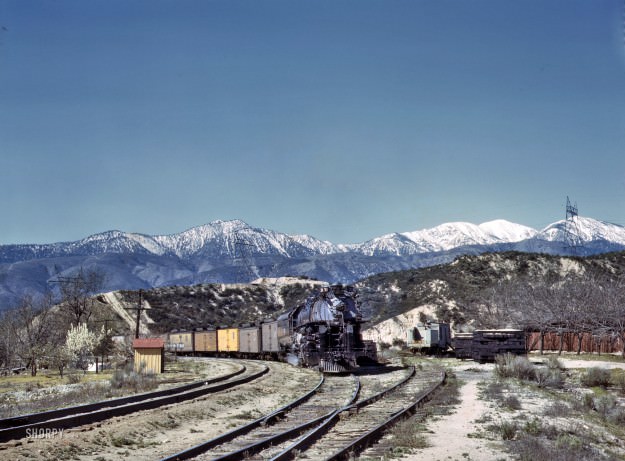
Snow-bright mountains loom beyond a quiet siding as an eastbound Union Pacific freight pauses at Alray, California, the rails curving gently into the open country of Cajon Pass. The locomotive sits heavy and purposeful on the track, its dark mass contrasted against pale ground and the crisp, high desert light. Even at a standstill, the scene suggests motion held in check—cars lined up behind, switches and ballast in the foreground, and the long corridor ahead waiting to be taken.
March 1943 places this moment squarely in the wartime West, when railroads carried the nation’s work with relentless regularity and efficiency. The title’s note that Union Pacific trains used Santa Fe tracks toward Daggett highlights a practical cooperation that shaped operations on busy mountain routes, especially where grades and bottlenecks demanded careful dispatching. Details that might be overlooked in a black-and-white reproduction—painted rolling stock, the blue of the sky, the cold sheen on distant ridges—come through in the 4×5 Kodachrome transparency and make the infrastructure feel immediate rather than remote.
Jack Delano’s Office of War Information photography often balanced documentary clarity with a storyteller’s eye, and this view does both while serving train-history readers searching for Cajon Pass railroading, Union Pacific freight operations, or Santa Fe trackage rights in California. The frame invites lingering: follow the rails from the foreground to the locomotive, then lift your gaze to the mountains that define the pass and the challenges it posed for steam-era power. As part of a larger journey documented from Chicago to California, it reads like a single held breath in a much longer, essential run.