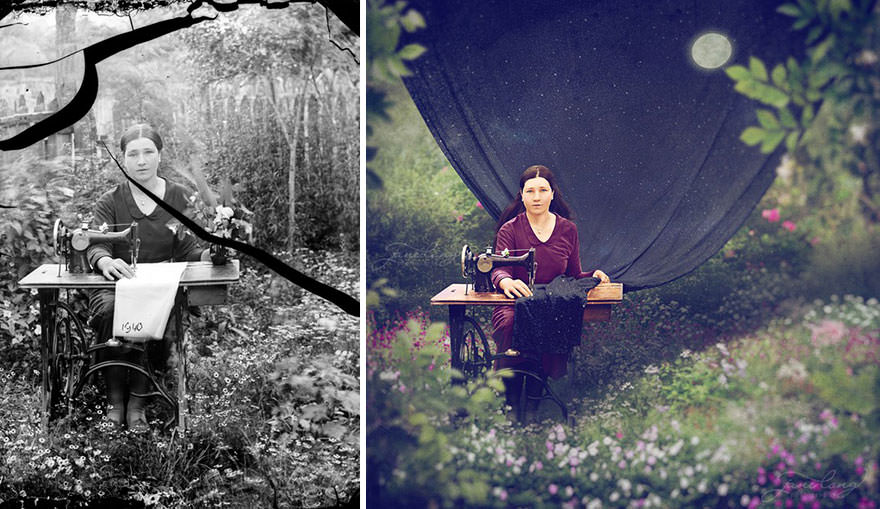
A young woman sits outdoors behind a treadle sewing machine, framed by a garden that looks both cultivated and slightly wild. In the original glass-plate negative, age announces itself through deep scratches and a bold crack that cuts across the scene, yet her direct gaze and steady posture remain unmistakably present. The mechanical details—the wheel, the tabletop, the fabric draped forward—quietly underline how central handwork and domestic industry once were to everyday life.
Colorization transforms that fragile monochrome record into something closer to a lived moment, without erasing its origins. The recolor introduces a rich, dark garment, the warm wood of the work surface, and a haze of greens and pinks among the flowers, lending texture to leaves, grass, and cloth. A conceptual flourish appears behind her like a theatrical backdrop, with a night-sky tone and a pale moon that pushes the image beyond documentation and into visual storytelling.
Rather than claiming perfect historical certainty, this artistic approach invites viewers to look longer, noticing the contrast between the damaged plate and the newly imagined palette. For readers interested in historic photo colorization, glass-plate photography, and the revival of early images for modern audiences, the pairing offers a vivid before-and-after meditation on memory, labor, and landscape. It’s a reminder that restoration can be both archival and expressive—part preservation, part re-interpretation.