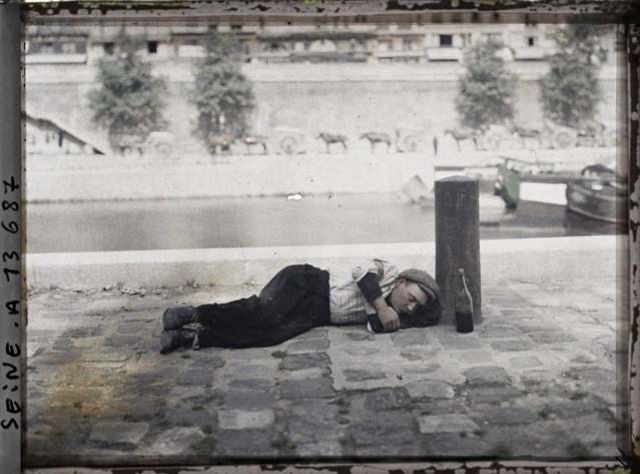
Along the cobblestones of Paris’s Dock Celestine, a lone figure lies curled on his side, hat still on, as if sleep arrived mid-journey and simply claimed him where he fell. A bottle stands upright nearby like a quiet witness, while a stout post anchors the foreground and gives the scene a sense of rough, working waterfront order. Behind him, the riverbank and distant façades blur into a pale backdrop, leaving the human presence—so small against the city—at the center of attention.
The colorization lends an immediacy to everyday hardship, turning a candid moment into something uncomfortably intimate rather than safely “old.” Clothing folds, the uneven stones, and the muted tones of the quay suggest a life lived close to the street and the Seine, where rest might come in snatched intervals instead of behind a door. It’s a reminder that Parisian history isn’t only grand boulevards and monuments, but also the ordinary bodies that moved through them, tired, broke, or simply overrun by the day.
For readers drawn to historical Paris photography, this scene on the dock offers a striking glimpse of social reality at the water’s edge—part riverside calm, part urban strain. The composition balances stillness and tension: the city continues in the background, yet time seems paused around the sleeper on the stones. As a WordPress post feature, “A Parisian asleep on the dock Celestine” invites reflection on labor, poverty, and the overlooked corners of Parisian life that archival images preserve with unsettling clarity.