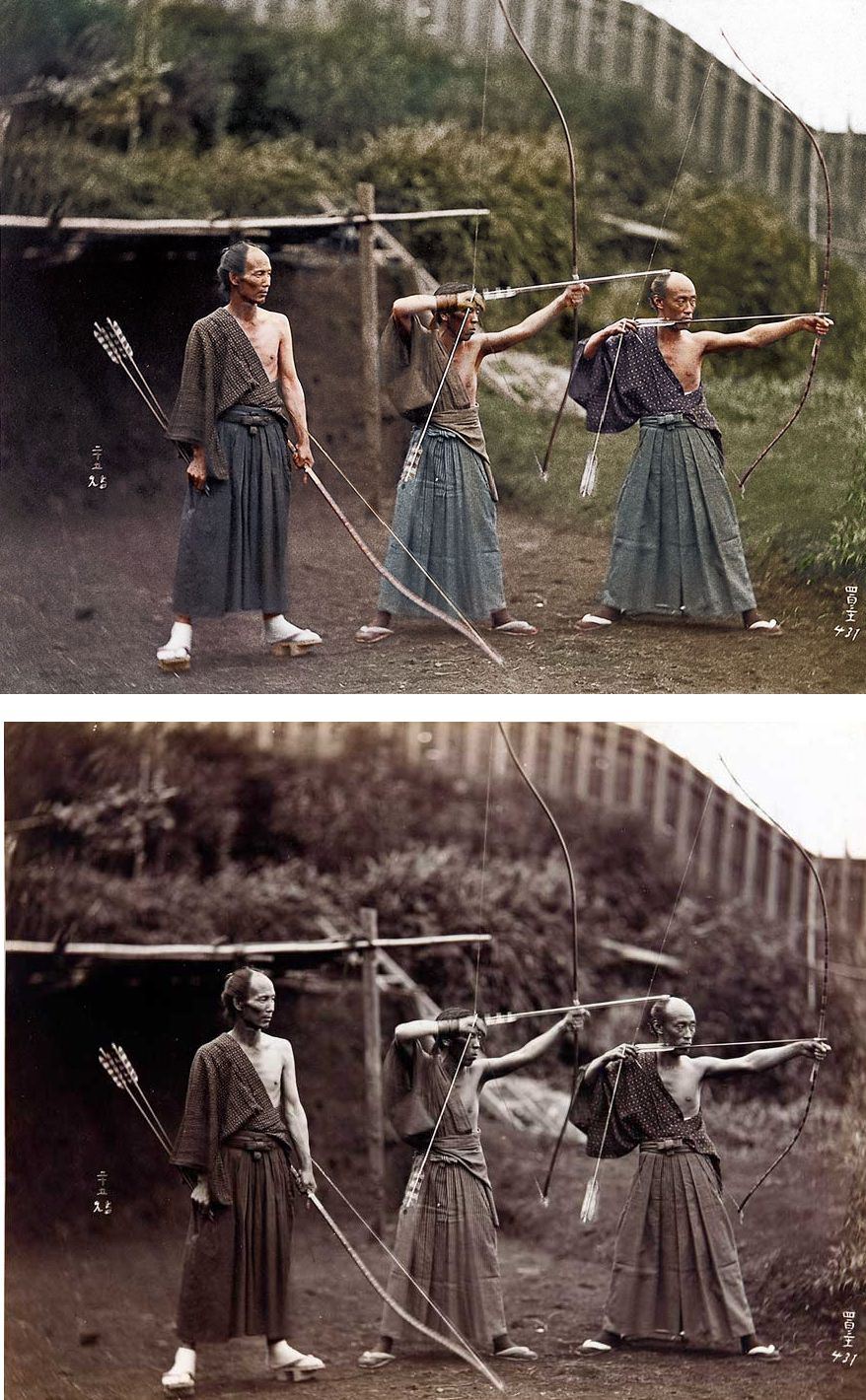
Three Japanese archers stand in a rough outdoor range, their long asymmetrical yumi bows towering above them as two men draw to full extension and a third waits beside a quiver of feathered arrows. The colorization brings out the muted blues and grays of hakama trousers and draped cloth, contrasting with bare shoulders and the pale fletching ready at hand. Behind them, a simple shelter and earthen ground set an everyday, working backdrop rather than a ceremonial stage.
What lingers is the discipline in the posture: the forward arm locked, the string hand anchored, the gaze fixed downrange with the calm concentration associated with Japanese archery. Even without a visible target, the scene reads like a lesson or demonstration, emphasizing technique over spectacle. Details such as the layered garments and sandals help place this in a traditional world on the cusp of rapid change around the mid-19th century.
For readers searching for early photographs of kyudo and samurai-era martial practices, “Japanese Archers, circa 1860” offers a rare, grounded look at how archery appeared outside of woodblock prints and later studio dramatizations. The pairing of the original monochrome image with a careful colorized version invites comparison—texture, fabric, and skin tones suddenly feel closer, while the composition remains unmistakably of its time. It’s a small window into training, tools, and stance, preserved in a moment of stillness.