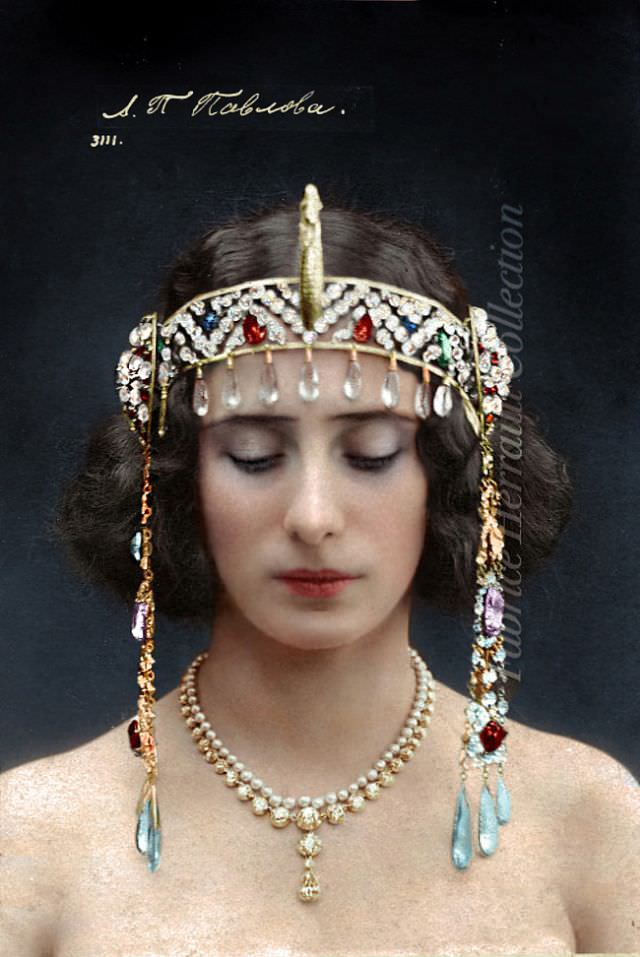
Lowered eyes and a perfectly still mouth give Anna Pavlova an almost sculptural calm in this 1910 portrait from *The Pharaoh’s Daughter*. The colorization draws you straight to the glittering headdress—arched like a diadem, studded with jewel tones, and finished with delicate, tear-shaped drops that catch the light. Against the deep, plain background, every detail of her stage persona reads clearly, from the soft styling of her hair to the poised symmetry of her face.
Ornament does most of the storytelling here: a central vertical element rises above the brow, while strands and settings frame the temples like ceremonial regalia. A double strand of pearls circles her neck, with a pendant resting at the centerline, echoing the measured balance of the headpiece. Even without movement, the costume suggests choreography—weight, sway, and shimmer translated into a single, controlled moment.
Seen today, the image works both as ballet history and as a study in early 20th-century theatrical glamour, preserving how performers were presented to the public beyond the stage. The hand-tinted palette emphasizes texture and craftsmanship, turning a familiar archival portrait into something newly immediate for modern viewers searching for Anna Pavlova, *The Pharaoh’s Daughter*, and classic ballet photography. It’s a quiet reminder that iconic performances were built not only on steps, but on careful visual myth-making.