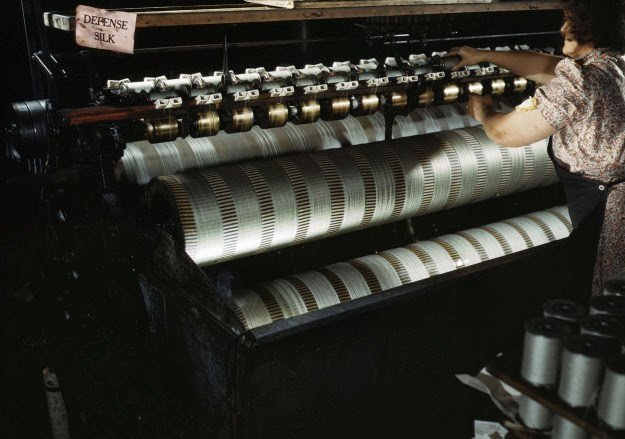
Industrial wartime production fills the frame in Manchester, Connecticut, where a water stretching machine is set up to pull parachute shroud lines to exacting standards. Ranks of taut, pale cords run across rollers and guides, turning a task that once depended on hand feel into a repeatable, calibrated process. A small sign reading “DEFENSE SILK” hints at how textile know-how was redirected toward military needs in 1942.
At the right edge, a worker leans into the mechanism, monitoring the lines as they pass through the machine’s tightly spaced fittings and spinning cylinders. The orderly pattern of threads and hardware conveys the rhythm of a factory floor: continuous motion, constant attention, and little margin for error. Even without seeing the parachute canopy itself, the shroud lines tell the story of reliability—every strand meant to perform when lives depended on it.
Colorization brings out the contrast between the machine’s dark housing and the bright, rope-like strands, making the scene feel immediate rather than distant. For readers interested in World War II home-front history, Connecticut industry, or the evolution of textile manufacturing, this photograph offers a vivid glimpse into how everyday materials were engineered into essential equipment. It’s a reminder that victory often relied on invisible work: measured tension, uniform fibers, and the careful supervision of machines built for precision.