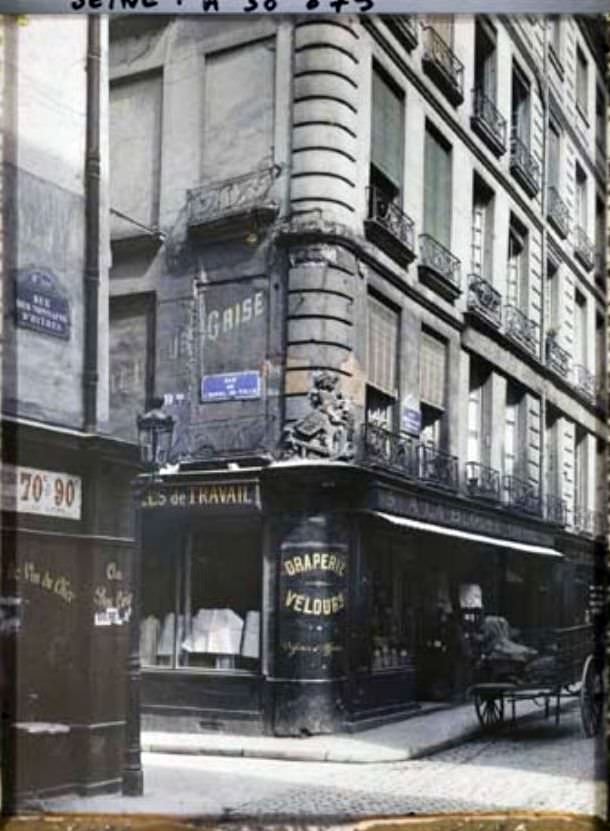
At the corner where Nonnains-d’Hyères meets the Hôtel de Ville, a tall corner building anchors the street like a quiet witness to everyday commerce. The rounded stonework, stacked balconies, and deep shopfront windows suggest a busy ground floor beneath residential rooms above, a familiar rhythm in many French town centers. The colorization draws your eye to the façades and storefront details, making the junction feel less remote and more like a place you could still turn into on foot.
The old sign is the scene-stealer, fixed to the corner as if it were a beacon for passersby navigating the intersection. Faded lettering and shopfront typography hint at the kinds of businesses that once relied on bold, readable branding—practical, proud, and designed to be noticed from several directions at once. Even without pinning down a precise era, the visual language of the street—metal railings, painted panels, and a substantial awning—evokes a time when retail life spilled right up to the curb.
Down at street level, the cobbled surface and the presence of a cart reinforce the sense of a working street rather than a posed postcard. It’s easy to imagine deliveries arriving early, conversations carried across the corner, and locals using the Hôtel de Ville nearby as a point of reference. For readers interested in urban history, signage, and the changing face of historic streets, this colorized view offers a richly textured snapshot of how architecture and advertising once shaped the experience of the city.