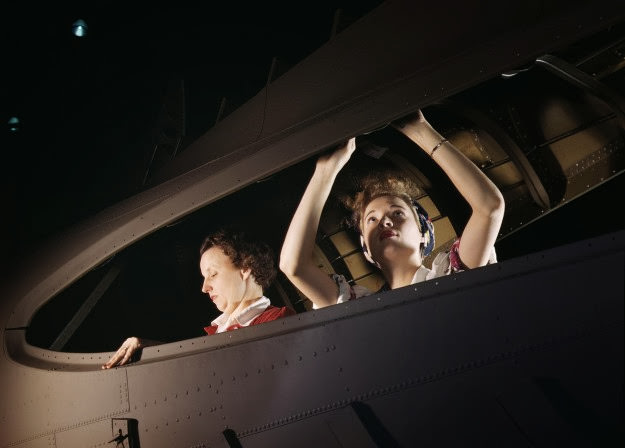
Inside a Douglas Aircraft Company assembly area in Long Beach, California, two women work within the curved opening of a plane’s fuselage, hands raised to reach components tucked beneath the overhead structure. The close framing emphasizes riveted metal skin, shadowed interior ribs, and the careful attention required to fit parts in a confined space. A modern colorization brings out the contrast between the dark aircraft body and the workers’ uniforms, making the industrial setting feel immediate rather than distant.
The scene speaks to the tempo of 1942, when wartime production pushed aircraft manufacturing to expand rapidly and reshaped who did the work on the factory floor. With tools and panels just out of sight, the women’s posture and focus suggest skilled, repetitive tasks—inspection, fastening, wiring, or fitting—done at arm’s length where precision mattered. It’s a reminder that aircraft were not only designed on drafting tables but also built by countless hands performing exacting labor under tight deadlines.
For readers searching World War II home front history, women in defense plants, or Douglas Aircraft Company Long Beach photographs, this image offers a vivid window into wartime industry and the growing presence of women in aviation manufacturing. The colorized treatment doesn’t change the story, but it helps highlight textures—painted metal, rivet lines, and the factory’s low light—that define the era’s production environment. Taken together, title and image point to a broader narrative: how factories, communities, and workers adapted as the United States mobilized to produce airplanes at scale.