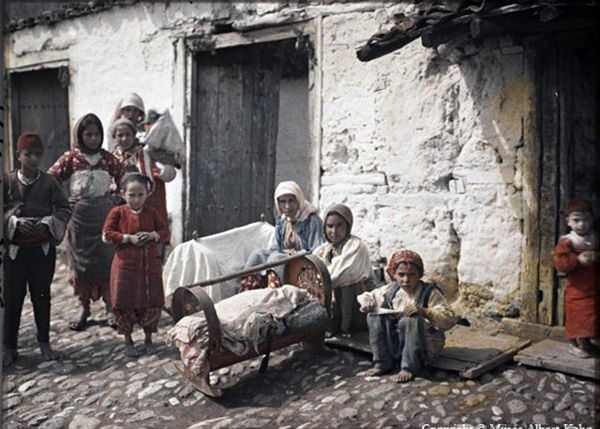
Sunlight spills across a cobblestone yard in early-1900s Serbia, where a cluster of villagers gathers tightly in front of a rough, whitewashed wall and heavy wooden doors. The colorization gives the scene an immediate presence: deep reds in clothing, muted earth tones in the stone and plaster, and the soft, worn textures of everyday fabrics. Faces turn toward the camera with a mix of caution and curiosity, as if the act of being photographed is still a novelty worth pausing for.
At the center, a simple metal bed frame has been carried outside, its linens bright against the weathered backdrop, suggesting a moment that is domestic yet communal. Women in headscarves sit close by while children hover at the edges, hands occupied and posture alert, creating a quiet portrait of family life and neighborhood support. Details like patched garments, sturdy shoes, and the uneven masonry hint at rural hardship, but also at resilience and the routines that held communities together.
For readers searching for Serbia history, Balkan village life, or authentic scenes from the 1900s, this restored photograph offers more than atmosphere—it offers evidence. The setting speaks through architecture and material culture: thick walls, narrow doorways, and a courtyard arranged for work as much as for living. As a colorized historical image, it bridges distance and time, inviting a closer look at how ordinary people looked, dressed, and gathered in the early twentieth century.