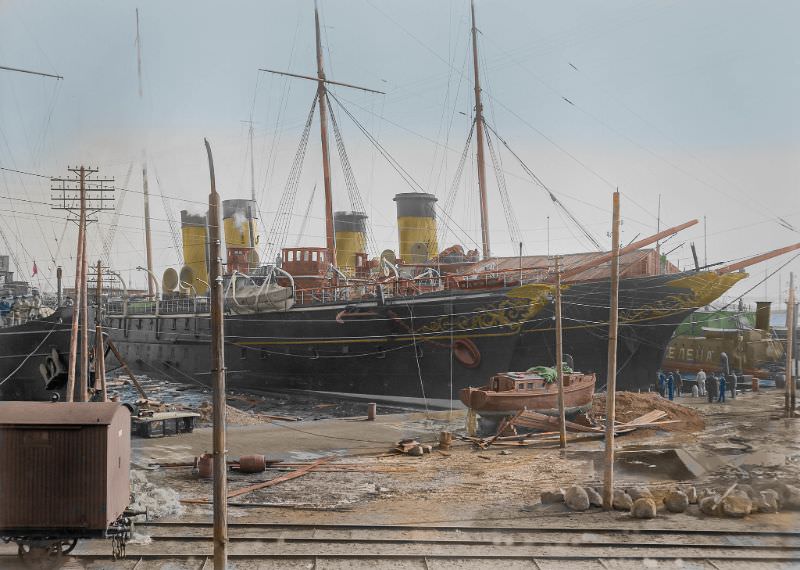
Moored close together in Helsinki, the former Imperial yachts “Polar Star” and “Standart” dominate the harbor scene with their tall masts, twin funnels, and long, dark hulls. The colorization brings out fine details that can be easy to miss in monochrome—golden trim along the bow, the warm tones of deck structures, and the pale winter light settling over the waterfront. Telegraph poles, rigging lines, and a clutter of dockside timber frame the ships like stage props, emphasizing their scale and status.
Along the quay, the everyday world presses in: puddled ground, scattered materials, and small craft hauled near the shoreline suggest maintenance work and the practical routines of a busy port. A handful of figures stands near the right edge, reduced to silhouettes by distance, yet enough to remind us how immense these vessels were when seen from the dock. Even at rest, the ships carry the visual language of prestige—sleek lines and ceremonial ornament—set against an environment built for labor.
For readers searching for early-1900s maritime history, this scene offers a vivid glimpse of imperial-era technology and style meeting the working rhythms of Helsinki’s waterfront. The pairing of “Polar Star” in front with “Standart” behind invites reflection on how symbols of power can be repurposed or simply linger in public view as times change. As a restored, colorized historical photo, it serves both as an atmospheric harbor portrait and as a document of naval architecture at the turn of the century.