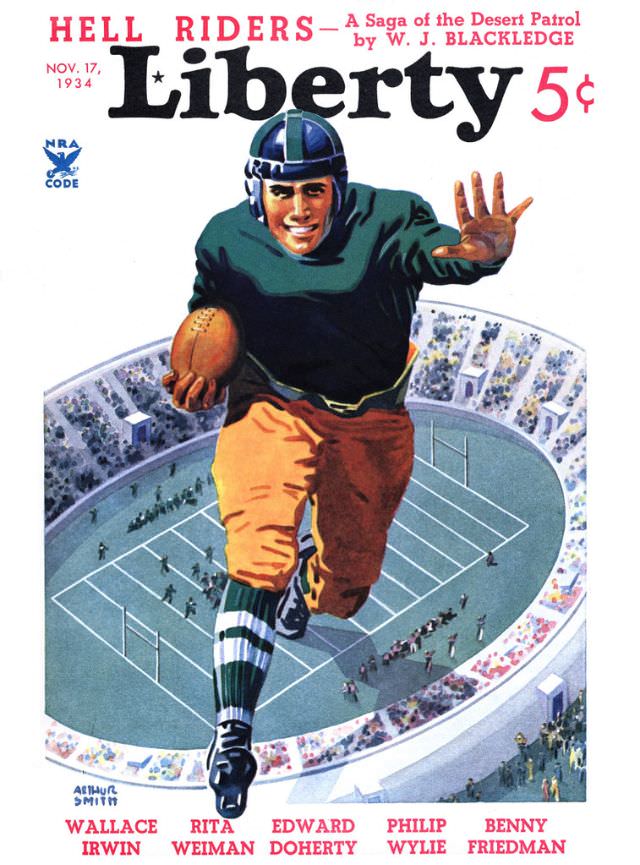
Bold lettering and a dramatic sports illustration make the Liberty cover dated November 17, 1934 instantly eye-catching, with the magazine priced at 5¢ and branded under the “Liberty” masthead. At the top, the teaser “HELL RIDERS—A Saga of the Desert Patrol” by W. J. Blackledge hints at the mix of adventure and spectacle that helped sell weekly magazines in the 1930s. Even the small “NRA CODE” emblem tucked to the side places the issue firmly in its era, when popular print culture and national policy shared the same newsstand space.
Charging straight toward the viewer, a helmeted football runner cradles the ball while throwing out a stiff-arm, his grin and forward lean turning the cover into a moment of pure motion. Below him, the stadium curves into view with a compact field, tiny players, and packed stands rendered in simplified, colorful forms—an illustrator’s bird’s-eye drama that amplifies the scale of the athlete. The effect is part sports poster, part cinematic close-up, inviting readers to feel the rush of the play before they ever turn a page.
As cover art, it also serves as a snapshot of how American football was marketed in the interwar years: heroic, modern, and larger than life. The artist credit “Arthur S…” appears at lower left, while a row of names across the bottom reinforces Liberty’s role as a showcase for writers and contributors alongside attention-grabbing visuals. For collectors, designers, and historians of magazines, this 1934 Liberty cover is a vivid example of period illustration, typography, and the newsstand storytelling that defined the decade.