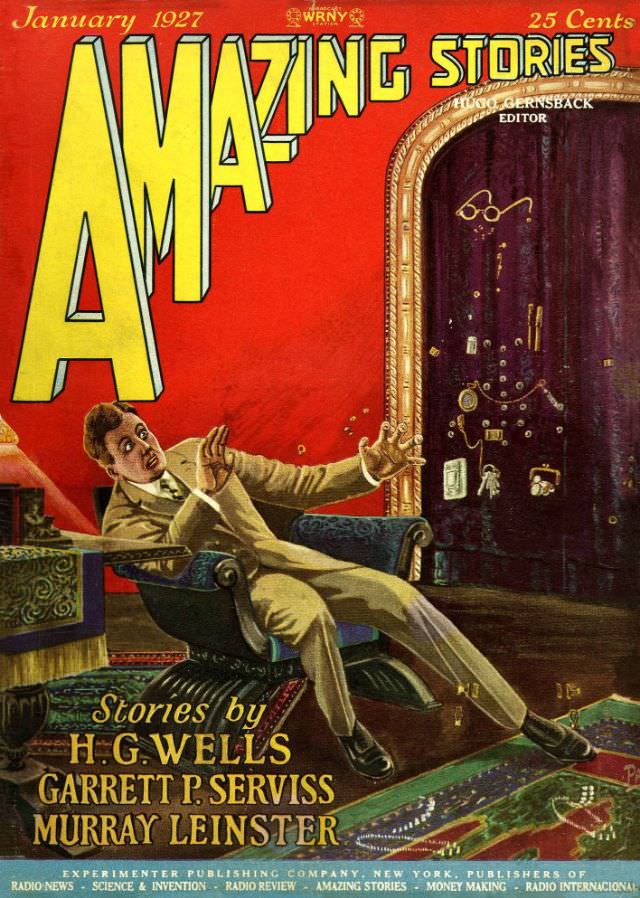
Bold scarlet and towering yellow lettering announce *Amazing Stories* with the confidence of a young genre eager to define itself, while the masthead notes “January, 1927” and the 25-cent price. The cover is staged like a miniature theater set: a well-dressed man recoils in an upholstered chair as if startled mid-thought, his hands raised in a reflex of alarm. Every element pushes drama to the foreground, from the heavy shadows to the crisp, poster-like color contrasts that made early pulp magazines jump off the newsstand.
To the right, an ornate, dark door becomes the story’s mysterious machine, studded with small components and curious fittings that suggest switches, locks, or experimental apparatus. The scene hints at the era’s fascination with electricity and radio—fitting for a magazine associated with Hugo Gernsback—where modern technology could feel as uncanny as any ghost story. The composition invites the viewer to imagine what’s about to happen: is the door a portal, a laboratory cabinet, or a dangerous invention about to spring to life?
At the bottom, the promised contents are part of the appeal, with names like H. G. Wells, Garrett P. Serviss, and Murray Leinster presented as a roll call of scientific romance and speculative adventure. This January 1927 cover art is a vivid example of early science fiction magazine design, blending melodrama, gadgetry, and typographic bravado to sell wonder in a single glance. For collectors, historians, and readers exploring the roots of pulp sci-fi, it’s a striking snapshot of how *Amazing Stories* helped make the future feel immediate.