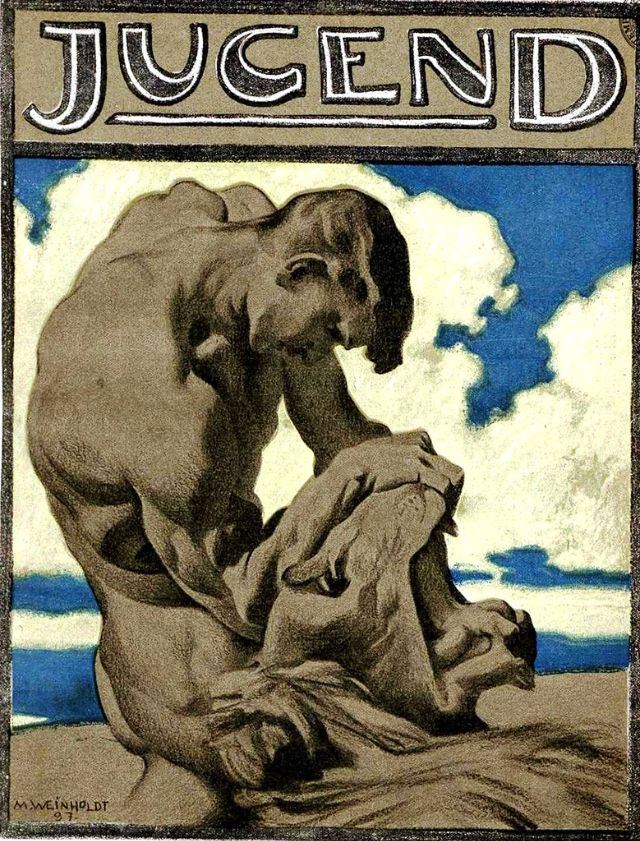
Bold lettering spelling “JUGEND” crowns this 1897 cover art, immediately placing it in the world of fin-de-siècle design where typography and illustration worked as a single statement. A muscular, nude figure dominates the foreground, rendered in sculptural tones that feel closer to stone than flesh, while a second body lies draped beneath, partially covered in flowing cloth. Behind them, a wide band of sky—deep blue against bright cloud—adds dramatic contrast and a sense of open air.
The composition leans into the era’s fascination with classical form and symbolic mood, balancing realism with an almost monumental stillness. Strong contours, shaded modeling, and the careful placement of limbs give the scene a carved, relief-like quality, as if the cover were presenting a modern myth rather than an everyday moment. That tension between idealized bodies and expressive atmosphere aligns closely with late 19th-century European magazine art and the emerging Art Nouveau sensibility.
As a historical image, “Jugend, 1897” also serves as a window into how periodicals used striking cover illustrations to project cultural ambition and artistic identity. The minimal setting keeps the viewer focused on gesture, weight, and the dialogue between the two figures, inviting interpretation rather than offering a tidy narrative. For anyone exploring Jugend magazine history, 1890s graphic design, or Symbolist and Art Nouveau cover art, this piece remains an arresting example of the period’s visual language.