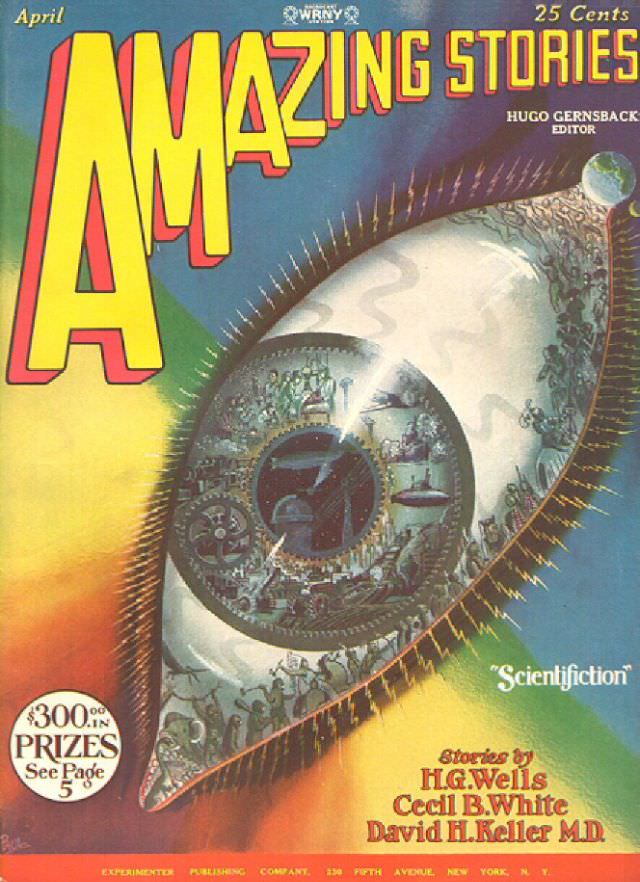
April 1928 arrives in a blaze of color and ambition on the cover of *Amazing Stories*, where the oversized “AMAZING” masthead shouts like a marquee and the cover price sits proudly in the corner. The layout balances bold typography with a dreamlike gradient background, the kind of graphic punch that made early science fiction magazines (“scientifiction,” as it’s labeled here) impossible to ignore on a newsstand. Even before a reader opens the issue, the design promises spectacle, wonder, and modernity.
Dominating the artwork is a vast, luminous eye that doubles as a window into another world, its iris packed with tiny scenes of machinery, structures, and busy human activity. A spiked arc frames the gaze like a mechanical halo, suggesting an instrument as much as an organ—part telescope, part surveillance device, part symbol of awakened scientific curiosity. The tiny globe tucked near the edge reinforces the cosmic scale, implying that the story’s viewpoint extends beyond ordinary horizons.
Printed details anchor the cover in its pulp-era context: the editor credit to Hugo Gernsback, the “300.00 in PRIZES” callout, and the promise of stories by authors including H. G. Wells. For collectors and historians of early science fiction, this *Amazing Stories* cover art is a vivid snapshot of how the genre marketed itself—equal parts futurist engineering, sensational imagination, and a confident belief that technology would reshape what people could see and know. It’s an iconic example of 1920s pulp illustration, built to stop a passerby cold and lure them into a universe of speculation.