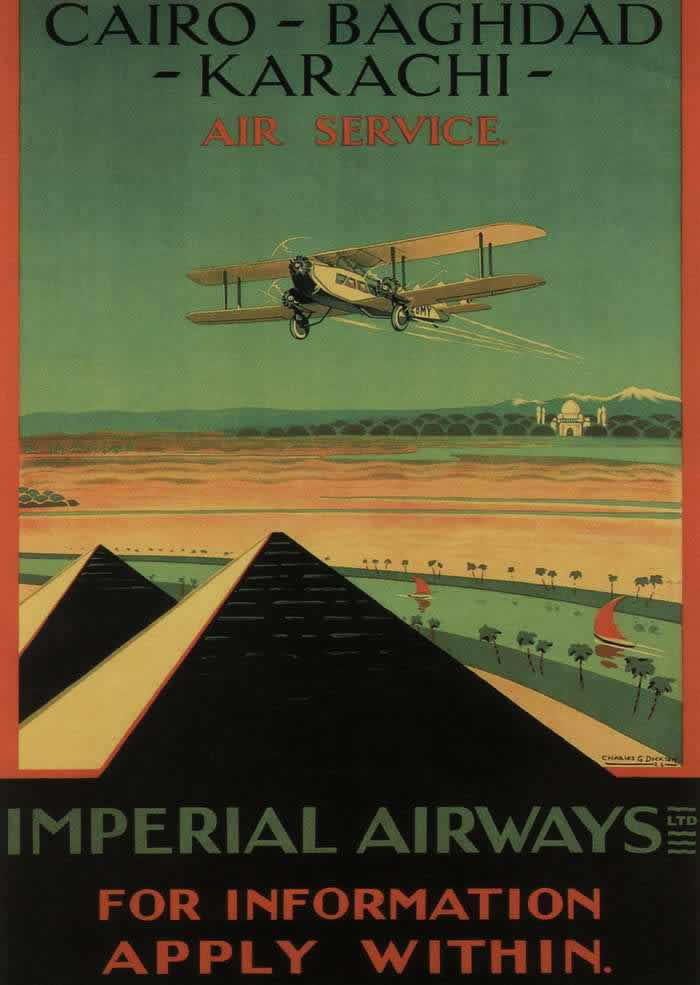
Bold typography announces a “Cairo–Baghdad–Karachi” air service, turning a long-distance route into a promise of speed and modern connection. Below the words, a biplane cruises across a wide, stylized sky, its clean lines and confident angle suggesting reliability as much as adventure. The design’s restrained palette and crisp lettering reflect how Imperial Airways posters in the 1920s and 1930s sold early air travel as an orderly, glamorous alternative to slower journeys.
Geometric pyramids dominate the foreground, anchoring the scene in instantly recognizable heritage while the aircraft claims the space above. A ribbon of river and a scattering of palms add calm movement through the landscape, and a distant domed structure hints at the monumental architecture travelers hoped to glimpse from the air. Together, these elements create a carefully curated panorama—less a precise map than a persuasive vision of the Middle East as seen through the lens of interwar travel advertising.
Imperial Airways’ name stretches across the bottom, followed by the enticing instruction: “For information apply within,” a reminder that booking once meant stepping into an office and buying into a new idea of mobility. Posters like this functioned as both timetable and theater, compressing multiple cities into one elegant composition that made empire-spanning routes feel coherent and attainable. For collectors and history readers alike, the artwork offers a vivid entry point into how aviation marketing helped normalize commercial flight and shape the romance of the skies.