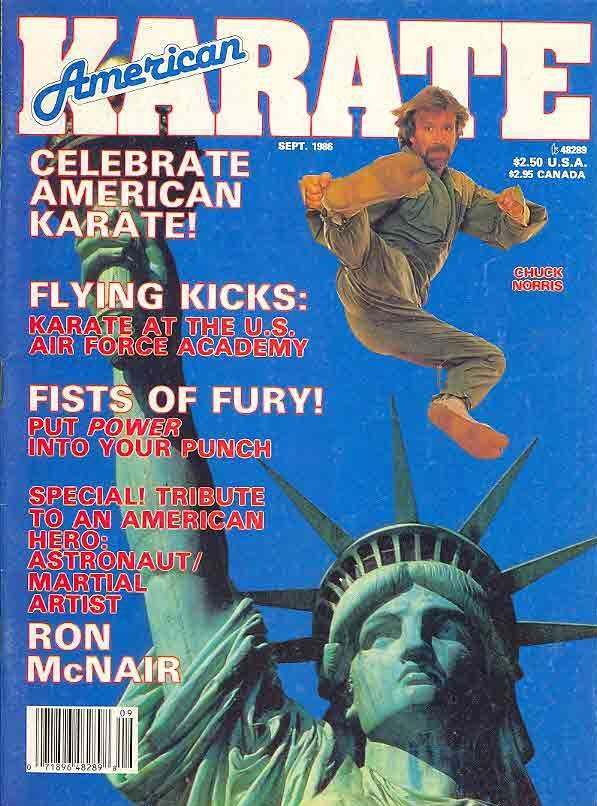
Bold, electric cover design announces the boom years of U.S. martial arts culture with a masthead that practically shouts from the page: “American Karate.” Against a saturated blue sky, a midair kick freezes in time above the Statue of Liberty’s crown, turning a familiar national icon into a backdrop for high-flying technique and pop bravado. The issue banner—“Celebrate American Karate!”—signals how magazines of the era framed karate not only as a fighting art, but as a modern American pastime.
Headlines crowd the layout in classic 1970s–1980s magazine style, promising both instruction and spectacle: “Flying Kicks,” “Fists of Fury,” and punch-focused training copy aimed at readers hungry for practical tips. A feature tying karate to the U.S. Air Force Academy hints at the period’s fascination with discipline, fitness, and institutional legitimacy, while the action pose reinforces the aspirational fantasy that martial arts media sold so well. Even the cover’s typography and color choices—big block letters, high contrast, and punchy red callouts—feel engineered for newsstand impact.
At the center of the attention economy sits the star power of Chuck Norris, printed right on the cover, a reminder of how martial arts magazines rode the same wave as action cinema and TV. The tribute callout to astronaut/martial artist Ron McNair adds another layer, connecting combat sports with hero narratives and broader American achievement. For anyone exploring the heyday of martial arts mags in the 1970s and 1980s, this cover art is a time capsule of how training, celebrity, and national symbolism were packaged into a single irresistible read.