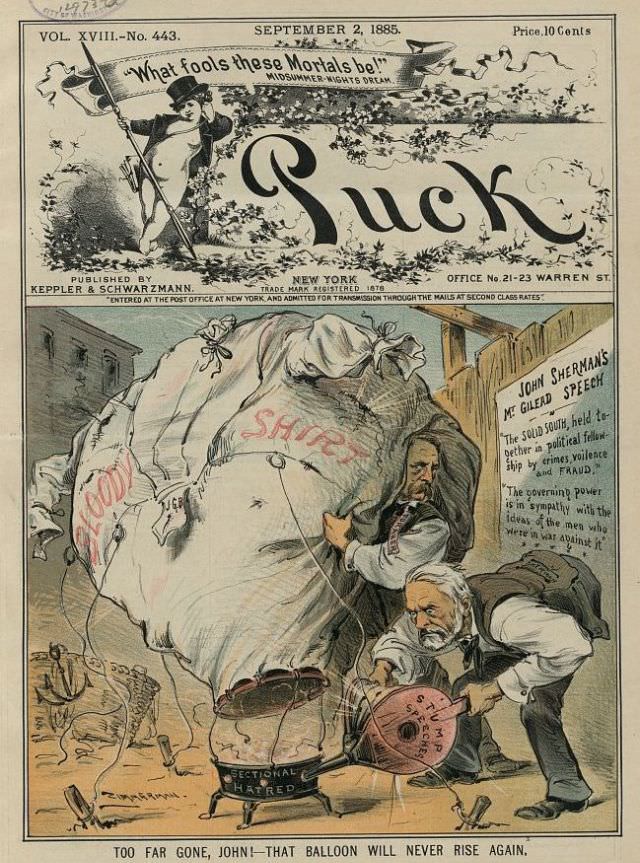
Boldly lettered across the top, the Puck magazine cover dated September 2, 1885 announces itself with theatrical flair, even quoting “What fools these mortals be!” in a nod to Shakespeare. The familiar masthead sprawls over a decorative band of foliage, while the issue details—volume number and a 10‑cent price—anchor the design in the everyday world of late‑19th‑century print culture. For readers browsing today, the typography and layout alone make a striking example of how illustrated weeklies sold wit, commentary, and spectacle at the newsstand.
Below the banner, the satire turns pointed: a strained political scene unfolds around an oversized, sagging balloon labeled “SHIPS,” tethered to a base marked “SECTIONAL HATRED.” A placard at the right reads “John Sherman’s Mt. Gilead Speech,” framing the caricature as a critique of rhetoric that, in the artist’s telling, cannot lift the nation so long as old resentments weigh it down. The weary figures, the cluttered ground, and the comically heavy apparatus all work together to make the argument visual—policy and ambition rendered as physical burden.
Printed by Keppler & Schwarzmann in New York, Puck used such covers to distill complex debates into memorable symbols, making this issue a rich artifact for anyone studying American political cartoons, Gilded Age media, or the history of satire. The composition rewards a slow look: from the expressive faces and exaggerated poses to the carefully placed labels that guide interpretation without needing a full article. As cover art, it stands as both a period advertisement for the magazine’s sharp tone and a window into what its editors believed readers were ready to laugh at—and worry about—in 1885.