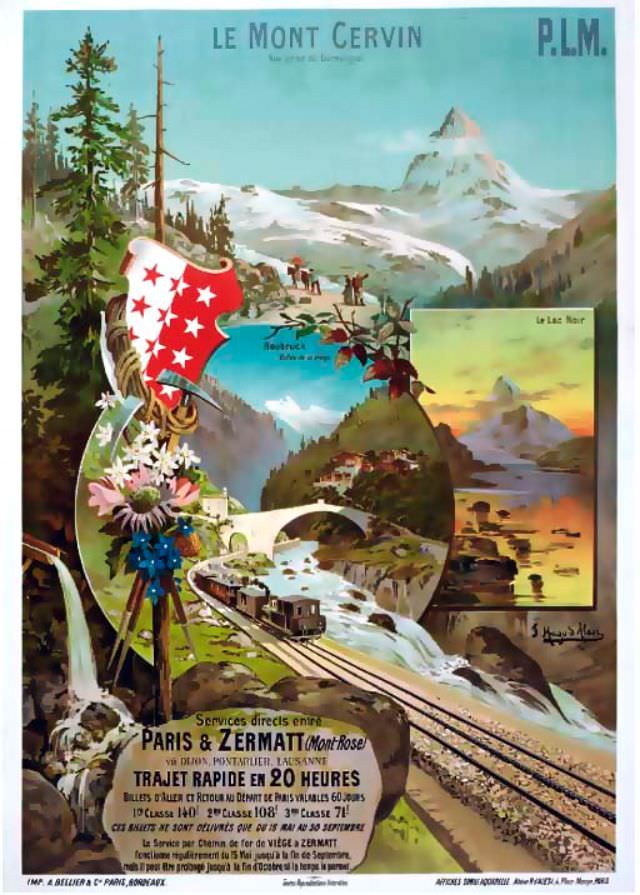
Across a pale alpine sky, the poster title “Le Mont Cervin” crowns a sweeping panorama that turns the Matterhorn into both destination and dream. A jagged, snow-laced peak rises beyond dark pines and glacier-bright slopes, while tiny figures on a ridge hint at the era’s growing fascination with mountain travel and adventure. The bold “P.L.M.” branding at the top signals its role as eye-catching railway advertising as much as artwork.
Colorful vignettes cascade down the composition like souvenirs pinned to memory: a red shield dotted with white stars, bouquets of wildflowers, and inset views that shift from cool mountain blues to warm, sunset-toned water. The layering feels deliberately theatrical—an invitation to imagine not only the summit, but also the valleys, lakes, and villages encountered along the way. Even without naming every scene, the overall effect is unmistakably late-19th-century tourism, where landscapes were packaged as romance, health, and modern mobility.
At the bottom, a train curves along the track beside rushing water, anchoring the fantasy in the practical promise of rail connection. French text promotes direct services between Paris and Zermatt and boasts of a rapid journey time, underscoring how the P.L.M. network marketed the Alps to an urban public eager for fresh air and spectacle. As cover art, this circa-1890s travel poster remains a vivid piece of railway history, alpine iconography, and early destination branding centered on the Matterhorn.