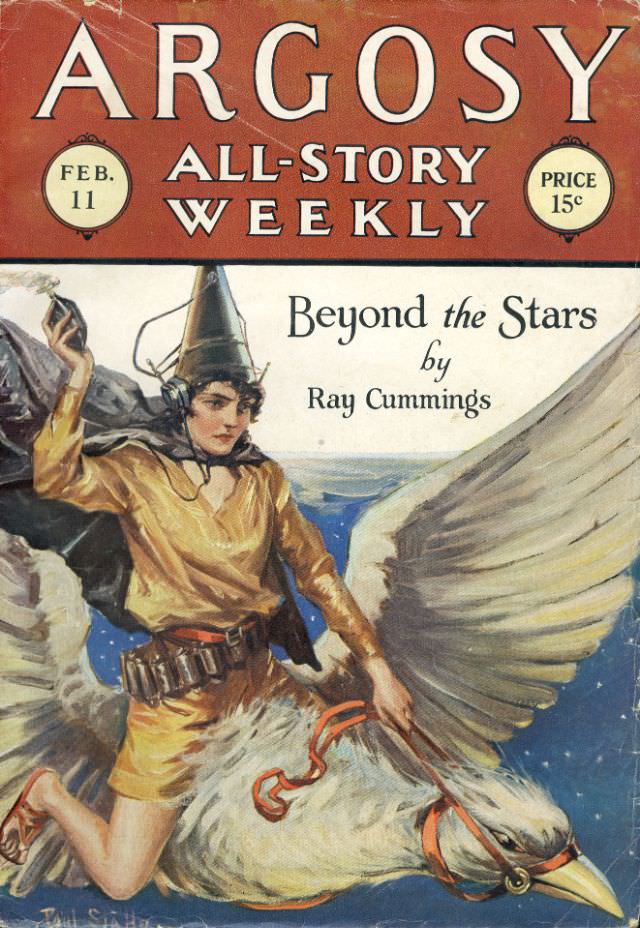
Bold lettering across the top announces **ARGOSY** and the promise of an “All-Story Weekly,” complete with the on-cover details **FEB. 11** and a **15¢** price—small design choices that instantly place the magazine in the bustling world of early 20th-century newsstands. The warm, reddish header frames a dramatic illustration below, a classic pulp-era layout meant to grab the eye from a crowded rack. Even before reading a line, the cover’s typography and color contrast set the tone for fast-paced adventure and popular fiction.
At center stage, a figure in flight gear clings to a gigantic bird over a deep blue sky, the creature’s wide wings spanning nearly the full width of the composition. A pointed helmet and headset suggest a blend of modern technology and fantasy, while the rider’s tense posture and raised hand heighten the sense of peril and momentum. The artist leans into motion and scale—wind-tossed feathers, a downward angle, and a tight grip—creating the kind of breathless spectacle that defined pulp magazine cover art.
Printed beside the illustration, the title **“Beyond the Stars”** and the author credit **Ray Cummings** hint at science fiction and otherworldly adventure, themes that helped Argosy build its reputation among genre readers. As a piece of 1928 ephemera, this cover is both a collectible artifact and a window into how magazines sold imagination: big type, bigger drama, and a story promise right on the front. For anyone researching Argosy, pulp illustration, or early science fiction in popular culture, this February 11, 1928 cover offers a vivid snapshot of what readers were invited to dream about.